Wednesday, 15 February 2017

What Is Wrong With These Men?


I have been wondering over this question, because I see in pictures in newspapers and other media reports, men in Tamil Nadu politics, perpetually in an attitude of worship. Both hands folded in the front in an act of supplication, bent slightly forward from waist onwards, head bowed and eyes respectfully cast on the ground, as in an act of worship, around a woman!

I am perplexed and wonder what is wrong with these men in Tamil Nadu? Not that they are in this postures in front of their wives, who are also women. In their own houses and with their own women, these men are like lions. They roar, twist their moustaches with their fingers, and demand respect and service.

The oft heard remark in Tamil Nadu cultural settings, especially from the parents of the bridegroom is, ‘how can he cook at home? He is born a boy!’ The male species of human beings in Tamil Nadu are not supposed to cook! That is demeaning for a man to engage in, especially at home! It is the woman’s job! How can you expect a man to do that?

The other remark which men in Tamil Nadu are supremely famous for uttering, especially to their wives is, ‘I wear the pants in this house.” That is supposed to mean that the husband is the man of the house and the wife better recognise her subordinate role in the marriage and behave. Her place is strictly in the kitchen.

It is almost like the male lion in a pride, which will not hunt its food, for the females, the lionesses of the pride join and hunt, but the first morsel of the bite will have to go to the male! That is the beauty of a lion, male, who presides over the pride of females and bosses over them and has the best served to him on the platter. Same usually holds good for the men in Tamil Nadu.

So, what really happens in the political world, where the same men, who are lions in their respective homes, bend forward with folded hands in an act of supplication and worship to a woman in power?

Is it a remnant of Shakti worship, where goddess Shakti is feared and worshipped for her ferocity and power and her willingness to give boons to her devotees?

One somehow tried to justify in this manner and in other ways, the Tamil Nadu Members of Legislature (MLAs) doing this obeisance to the then Chief Minister Jayalalitha, respectfully called ‘Amma,’ ‘mother,’ by everyone. Alas, she is no more. After all, when she was alive, she was a power to reckon with.

But, in a minute, after Amma died, they started doing this obeisance to ‘Chinnamma!’ This ‘little amma,’ literal translation, aka Sashikala is no other than the one who served Amma during her political sojourn, loyally, almost like a servant. Now these MLAs switched gear and have started to worship this lady!  Really, what is wrong with these men?

Leave alone Chinnamma, now a new figurine has emerged, in Deepa, the niece of Jayalalitha, who has thrown her hat in the ring, as it were, and Paneerselvam, the present caretaker Chief Minister, and his coterie are seen in the oft seen attitude of worship around this girl, a mere straddling in political world! How do you explain this?

Is it money, power and position that makes these me bend backwards and forwards, and lie prostrate in an act of worship before these Ammas and Chinnammas? Are they so spineless and cowardly in front of power and authority? Or are they just greedy for the opportunity to make money under the protection of these goddesses and escape with their lives? What is it?

Money is a big attraction, I am sure. Politicians thrive on corrupt money and Jayalalitha was no exception. This has been proved by the Supreme court decision, which came in just a few days back indicting Jayalalitha and her coterie for having made illegal money during their regime. Fortunately for Jayalalitha, she is dead and managed to hoodwink even the Supreme Court of India!

The same cannot be said about Chinnamma, who along with her two other partners, has been interned in the Bangalore jail just last evening. Is it for this corrupt money and the power that comes along with it, that the men, MLAs in Tamil Nadu, are prostrating before the powers that be?

Sashikala has cleverly cornered all the property and money of the dead Jayalalitha and is in charge of the party money. No wonder these men are falling at her feet now.

Position of authority as a Minister in the cabinet or even a Chairman of a Board, and State Public Sector Units, means power and means to milk the perennial cow, the State budget meant for schemes. Proximity to the Leader, the Chief Minister, means an MLA or a party worker can land in one of these lucrative posts and make money and enjoy all the perks associated with the post.

Is it for this these men sell of their dignity and self-respect and lick the dust in front of these Ammas? What a sad scenario for Tamil Nadu. Not that it is any better in the other parts of the country, but still it is not this bad.

One does remember the pressure brought on Sonia Gandhi to become the President of National Congress after the assassination of her husband, Rajiv Gandhi. Main reason, she held the keys to the party funds and also carried the legacy of the dynasty established by Indira Gandhi. All that the others have to do is to just stay in the shadow of this legacy and milk the cow and enjoy the loot.

I am hoping that one day this scenario will change and people all over India will not just be pleased with the crumbs these politicians throw under their table and really elect some honest and worthy leaders as their political representatives and behave with dignity required of a human being, both inside their homes and outside in the political arena.  


God bless Tamil Nadu and God bless India! 

Saturday, 11 February 2017

"Water, Water, Everywhere!"


This time, I think I got it right. Like Coleridge’s Ancient Mariner I shouted but with glee, ‘water, water, everywhere, but not a drop to drink!’ I was standing mesmerized at Dhanuskodi, viewing the vast swathe of low tide, which brought in the sea waters of Bay of Bengal to my feet.

Dhanuskodi is a ghost town. It was wiped away completely in an immense cyclone that hit the area in December 1964. Bay of Bengal, the sea that laps on the eastern border of India and Indian ocean that covers the southern side of the country, which derives its name from the country India, meet at this point in Dhanuskodi. It lies in Pamban island connected to Mandapam in the main land by Pamban bridge. Dhanuskodi is the last point of land in India as it tapers towards the island Sri Lanka, which takes shape from that point.

Traditions have that Rama, an ancient king of India from the north, the hero of Ramayana, an epic poem of ancient India, came in hot pursuit of Ravana, who had kidnapped his wife, Seetha and held her captive in the Sri Lankan island. His friends built a bridge at Dhanuskodi for his troops to cross over to Sri Lanka.
                                                            
                                                               
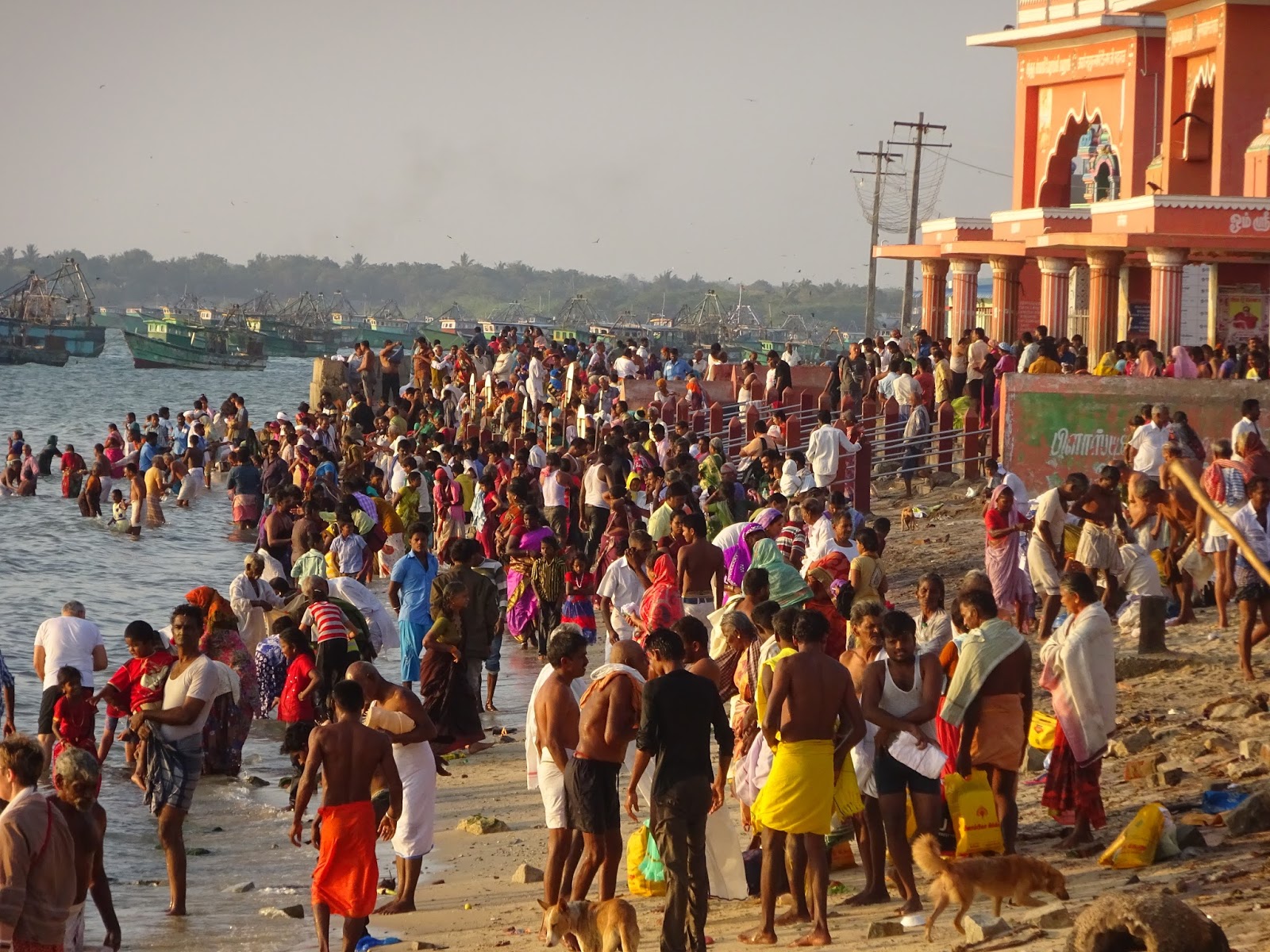
                                                                People taking a dip in the ocean, Rameswaram                                                                  temple


Rameswaram, the town that lies in Pamban island, is one of the four most important pilgrimage centres for the Hindus, the others being Badrinath in the north, Puri in the East, Dwaraka in the West. This cultural unity defined the country India, though it was never a unified country under a single ruler until the time of the British. The closest geographically to today’s India was under Aurangzeb, the last powerful king of the Mughal Empire.

My interest in the place was not definitely religious. But that didn’t deter my companion taking a wistful plunge in the sea and observing all the rituals connected with it, including 22 buckets of water poured over her head as theerthams and emerging completely satisfied like a cat that has got its stomach full with good milk!

I was fascinated by the story of the cyclone that hit Dhanuskodi. A low pressure that built near Andaman and Nicobar Islands in Andaman sea, east of Tamil Nadu in India, on 18th December 1964, developed into a cyclone of mammoth proportions. By 23rd December it developed into a hurricane with a wind velocity of 240 km/h (150 mph) and struck the then Ceylon (now Sri Lanka) near Mannar, causing extensive damage and loss of life of over 2000 people.  

On the Indian side Pamban island bore the brunt. Dhanuskodi lay almost at the tip of the island on Indian side as it tapers towards Sri Lanka and on the other side it was Mannar of Ceylon. Dhanuskodi was completely submerged under the deluge. Huge tidal waves of 25 feet (7.6 meters) washed away everything that was standing in the place.

A passenger train carrying 110 people and 5 railway staff got completely washed away, killing all the passengers. The train was coming from the mainland through Pamban station to Dhanuskodi station. The time was 11 pm and the train was just minutes away from reaching Dhanuskodi station. Huge tidal waves hit the train and it was seen no more. Today all that is left of the train are some twisted metal of the train tract, a witness to that gory night of disaster.  

The Pamban bridge that was connecting Pamban island with the mainland at Mandapam on the east coast of Tamil Nadu got washed away as well. The bridge was rebuilt only in 2012.

Dhanuskodi was declared by the Government of India as a place unfit for human habitation. I was reminded of some of the Old Testament towns, which were destroyed in war and prophesied that they will never again be inhabited by people. One such place was Jericho. Many of the towns mentioned in the Old Testament still stand, but not Jericho. It is a dead city. So also Dhanuskodi.

We travelled in minibuses to the ghost town and these buses full of people were winding their paths in and around the low tide area, over puddles of sea water left behind by the tide, with twists and some dangerous turns. I was reminded of the Jeep Safari on the sandy deserts of Dubai, where the drivers took their vehicles over the sand mounds and would suddenly sweep down giving the passengers a thrill or fear depending on the person concerned.

The sea itself looks so calm and quiet and innocent. It is nicknamed as the ‘lady sea,’ especially during such low tide. The present day Dhanuskodi looks deserted, except for some 20 odd families, living there in shacks, selling pebbles and shells and some ‘nimbu pani’ (lemonade).

The best was the lemonade was made with water drawn from a well simply dug in the ground close to the shop and sweet water to drink in a place surrounded by sea water. Amazing! 
                                                                The well!


Remnants of a church is seen, so also a water tank and the post office–cum– railway station. A school lies in shambles. A once thriving town has been reduced to an uninhabitable place.


However, all hopes are not lost. A new road is almost complete, connecting Dhanuskodi with Rameswaram. This is being constructed at a cost of Rs. 5 crores financed by the central government. After almost 50 years, once more the town will be connected to civilisation.

It might be built again, you never know.

Hope, after all, is the beacon of life!


Thursday, 2 February 2017

Pain and the Universe


One certainty in an uncertain world, they say, is death. Witnessing sickness, suffering, old age and death, was what drove the young prince Siddhartha to renounce the world, sit under a Bodhi tree and eventually get enlightenment. The one sure thing in the world is suffering and the associated pain.

Hinduism teaches that people are suffering because of the sinful deeds they had committed in the previous births. That is the karma theory. These deeds or karma must be paid by an individual by taking another birth, by suffering that is due to him or her and working to overcome it out by doing good deeds, according to the strata of society in which he is born and placed in the present birth. That is Varnashrama Dharma and it led to Hindu Caste system.

Gods and goddesses of Hinduism are considered above suffering and pain, because it is held that being gods, they are above sin and karma theory. It applies only to the human beings. Hindu philosophers warn humans that they should not see the lives of gods, sinful or not, and copy it, because then karma will catch up with them and not the gods!

Under the Advaita philosophy of Hinduism, that is propagated in the West by popular Swamis, god is morally neutral and is above good and bad. God is Paramatma, the Supreme Soul, which is an effulgent, blissful state, which is the goal for human beings to achieve.

Atma, the soul of every individual human being, will at the end, after having paid the price for all its accumulated bad karma over thousands of births, by suffering and doing good deeds, gets released from the world and the cycle of birth and death, merges with the supreme Soul. This is the mukti, the final release, which a Hindu would look forward to in life.

God, for a Hindu, is Ananda, blissfulness, and above good and bad, untouched by sorrow and suffering, which afflicts the human beings.

Buddha, who broke away from the caste system of Hinduism, kept the concept of karma and payment through suffering by individual human beings. He taught that suffering itself is caused by desire and attachment to material things in the world and hence desire for these things should be shunned.

The root cause of suffering, according to Buddha, is desire. On annihilating that desire, one can attain peace and tranquillity and be above the world of suffering and sickness. To achieve this impossible feat, he laid before his followers, the Golden Middle path and that of the life of a monk, without any attachment to the worldly things.

Islam does not believe in karma theory. One God Allah, though merciful, is a taskmaster. One must engage in many rituals, five times of worship or namaz, Friday worship at the Mosque, practice charity, go on pilgrimage to Haj, and show obedience to Hadiths, the traditions of the prophet; all are emphasised for being a good Muslim.

Allah is the final judge and he will admit a Muslim into heavens, based on his/her good deeds and obedience to the rules and regulations laid down in the Quran and the Hadiths. However, one can never be sure of one’s place in heaven, for it is left to the Judge, Allah.

Under Islam also there is no question of Allah suffering any pain, for he is the God and above all these sufferings, which afflict only human beings. It will not touch the almighty God, Allah.

So, the question is, can God undergo suffering? Does He know what pain is? Does He go through the emotional turmoil that we go through? Does He know what it is to lose a loved one to death? Disease and death and suffering, do these human afflictions touch God? Is He sensitive to these? These are some of the questions that arise in my mind as I meditate on these matters.

Christianity deals with these questions differently. God is looked upon as a Father, a personal God, who cares for His creatures, especially human beings, men and women, whom He created in His own image and entrusted the governance of the world He created in their hands.

God is Almighty and definitely above sickness and death and disease; otherwise He will not be a God. But, God of a Christian, is a God of emotions and feelings and He expressed His pleasure or displeasure through His devoted followers. For example, when God saw that wickedness had increased on earth and that every intent of the thought of men was evil, He regretted that He made man. Genesis 6:5.

Jesus Christ, the explicit revelation of God Himself in human form, was a man of emotions, when he lived on earth. He cried at the death of his friend Lazarus. John 11:33,35. He got angry, when he saw money lenders and other traders made the Temple of God, the ‘house of prayer,’ into a place of business, ‘den of robbers.’ Luke 19:46.

He knew what it is to be hungry, experienced thirst, and was tempted by circumstances and the Devil in all the ways as we are being tempted today. Jesus knew what it is to suffer want and deprivation and face desertion by his own disciples.

Jesus himself, personally went through suffering and death at the hands of his distractors, the Jewish religious authorities of that time. He was whipped, and his lacerated body was nailed to a cross. He died on the cross, suffering the agony of crucifixion under Roman governors.

God, a Christian would say, knows suffering and pain. God the Father had to see His Beloved Son, being crucified. It must have pained His heart. Still that was His plan, to sacrifice His Son, to pay the price for the sins of human beings. He removed the suffering of mankind, through the suffering of His own Son.

Anyone who believed that Jesus Christ died for his or her own sins, regretted and repented the sins committed, would be saved, said a loving God. John 3:16. That was the path of salvation for human beings He had provided in His Son. No one need to carry his or her sins and try to work it out by doing good deeds any longer. Jesus has done that job of paying the penalty for sin. All that one needs is to believe in Jesus. Hebrews 10:9,10, 12.

That is not the end of the story. The dead Jesus rose again on the third day! Resurrection gave humanity a hope, a hope beyond the grave or cremation. A hope that we will also rise alive at the end of the Age, and inherit eternal life, if only we had believed in Christ. 1 Thessalonians 4:13,14.

What a hope! And this hope comes out of suffering and death and seemingly destruction. But Jesus Christ conquered it all. No more pain and sickness or sin and death, but eternal life, through Jesus Christ. God Himself will wipe away all our tears. Revelation 21:4.  

A God who knows suffering and permitted that suffering to redeem the world of sinners with bad karmas, paying the price Himself, taking the burden on Himself, and extending eternal life to all who believe in Him, would be the real God.


Happy are those who trust in Him, for they will inherit eternal life. 

Wednesday, 25 January 2017

Flowers, Flowers, Everywhere!


So could have cried the Ancient Mariner, ‘Flowers, flowers everywhere!’ It was a sea of colours, beautiful beyond compare. Lal Bagh has come alive with animals made of pure roses, standing tall, elephants, giraffe, peacock and butterflies.

The glass house itself was a riot of colours. The four corners of it had mounts of colios and begonias with variegated leaves. In the centre stood the Gol Gumbaz, fully covered with red and white roses.

An archaeological marvel, God Gumbaz is the mausoleum of Sultan Mohammed Adil Shah, who ruled Bijapur in the 17th century. It has a huge circular dome, of 44 meters’ diameter, comparable to that of St. Peter’s Basilica of Vatican City, and it rests on eight intersecting arches. Bijapur lies in the State of Karnataka.

The Horticultural Society, which undertakes these laborious labour of love twice a year, once in January to commemorate the Republic day and the other one in August, to coincide with the Independence Day, has well-chosen the Gol Gumbaz as the central piece of attraction this January.

Lal Bagh itself is a place of interesting history. Translated as Red Garden in English, Lal Bagh, has a chequered history. It was originally commissioned by Hyder Ali, the Ruler of Mysore and was completed by his son Tipu Sultan in 1760, with 40 acres of land. It was designed on the model of Mughal Garden, especially the one in Sira and was later developed into a huge botanical garden by the local leaders and later by the British.

The Glass House which lies in the centre of Lal Bagh was constructed in 1898, by the then Superintendent John Cameron, based on the model of London’s Crystal Palace.

The other name associated with Lal Bagh is Krumbiegel, a German Botanist, who devoted his life to bring in exotic plants to the garden. He was requested by Krishnaraja Wodeyar, the then ruler of Mysore, to take over the affairs of Lal Bagh as its Superintendent, which he did in 1908 and worked there till 1915. He continued to live in Bangalore and when he died in 1956, he was buried in Bangalore itself.  

However, it is the name, Marigowda, that steals the show. M.H. Marigowda took charge as the Superintendent of Horticulture in 1951 and worked hard to make horticulture thrive in Karnataka. A separate Department of Horticulture was created in 1963 and he became its first Director.

During his tenure, he created 357 farms and nurseries throughout the State of Karnataka and elevated Horticulture as the most important activity, next only to Agriculture in the State. His foresightedness and tireless work have contributed to Karnataka being known as the Horticulture State of India.

Right now, Lal Bagh has 240 acres and lies right in the middle of the ever-burgeoning city Bangalore, providing it with the much-needed lung space, amidst the ever-growing traffic pollution in the city. It has around 1854 species of plants from all over the world.

A major attraction inside the garden is the Lal Bagh Rock, some 3000-million-year-old ancient rock formation. People of Bangalore and visitors hang around the rock, relax sitting on it in the evenings, munching peanuts or anything else which the local vendors sell them. Any tension created by modern lifestyle just evaporates there.

Atop this rock another historically important object is found, the Kempe Gowda Tower. It is one of the four towers erected by the founder of Bangalore town and a local ruler, Kempe Gowda, to earmark the southern boundary of his jurisdiction.

Well, many more interesting features are found within the 240 acres of the Garden, including a lake and Japanese Garden. So, when you are in Bangalore next time, do not miss looking for Lal Bagh and all its special features. It will leave you mesmerized, I am sure.


Be Bangaloooored! 

Wednesday, 18 January 2017

Mass Molestation or Mass Indiscretion?


Bangalore, the capital of Karnataka State in south India is a place known for its salubrious weather, also called as the Garden City for it is famous for its gardens and parks and flowers and the birds twittering.

Many Public-sector undertakings, engineering colleges and higher education institutes abound in the place. These days it is known for its IT companies, and the city is called the Silicon Valley of India.

Thanks to software companies, sprouting all over the city, youngsters from all most all the parts of the country and from all over the world congregate in the city in search of employment. It is known for its cosmopolitan culture, open-mindedness and liberal outlooks.

Bangalore also has the dubious distinction of being the suicide capital of India and of late is famous for its traffic jams and snarls. The city is just bursting at its seams, as if it is not able to handle itself any more.

On the top of it all comes the accusation that there was mass molestation on New Year’s Eve in Mahatma Gandhi (MG) Road and Brigade Road, where thousands of youth had congregated to celebrate the birth of the new year, 2017.  

Youngsters gathering in MG road and Brigade road is not a new thing for Bangalore. It has been happening for the last 35 years and more. Boys do go overboard and indulge in general merry making, thus enjoying themselves.

The police and others turn an indulgent eye to this and let the boys be boys. But nothing untoward happens. At the most, young couples and women and elders avoid the place at that time of the year.

This year it was all different. News went viral on social media that girls were molested on that night at MG road and Brigade road and that there was ‘mass molestation’ on New Year’s Eve. Girls were groped and molested in the crowd and the State government was not able to protect the girls, it was complained.

Reports from other sources do not support that accusation. In a crowd of 30,000 to 50,000 people, people do get jostled, pushed and shoved around. Surprisingly no complaint was lodged with the police. Scanning 40 CCTVs from the area by the police did not show any such mass molestation.

Bangalore witnesses many such mass gatherings every other month or so. To narrate a few recent such gatherings, I would cite the following.

It was Chithra Santhe on 15th January where the whole Kumara Krupa Road is blocked for vehicles and people from all over the country exhibited their art-work and people thronged to go and buy paintings at a throwaway price. It is crowded beyond imagination. But no untoward incident happened for the last 14 years, since it is on.

Avere Kalu Santhe, where freshly harvested beans are sold, happens every year in winter and this year also it happened around 7th January at Sajjan Rao circle and crowds jostle there too. But no complaints, excepting for the discomfort of the crowd and buying and selling and haggling and of course, the general merriment.

In November last it was Kadalai kai Parishe, where the newly harvested groundnuts come to the market and is sold in an annual groundnut fair in Basavangudi near Bull Temple Road. No such lewd incidents. And the Flower shows that happen twice a year - incident free.  

So, what happened on this New Year’s Eve? Is it possible that a few such incidents happened? Possible, but to term it as mass molestation is not fair to the city, I would feel. The city, in my opinion, is still a very safe place for girls.

May be, in the final account it is all about women’s rights. Today’s girls and their parents claim that girls have every right to enjoy a New Year’s Eve at MG road or Brigade road just like the boys, for are they not equal? And, they cl further that it is the duty of the State/city to safeguard the girls in such events.

This sounds a bit contradictory. If girls are equal to boys and should be allowed to enjoy freedom to celebrate in the middle of the night in the streets, then why the protection by the State? Are the boys being given protection? Why girls alone should be given protection? If so, the very claim that they are equal falls face down.  

Instead of insisting on equality in such things, I would say, it is better that girls learn to avoid such places for their own security. Knowing that on such days, boys will be on high, why insist on equality and go there and play with fire? Then cry upon the shoulder of a woman police? Can the government provide a police escort to each girl? Is it possible at all?

It is height of indiscretion to insist on such wild behaviours in the name of equality. Yes, women are equal to men, more than equals I would say, in studies, opportunities to work, to go abroad, to conquer the world, be an achiever and reach one’s full potential. But to go to MG road in the middle of the night to celebrate and then insist on police protection? That is indiscretion in my opinion.

In India, the culture does not permit as in the Western world, for boys and girls to hang around in a crowd and celebrate New Year or any other day in each other’s company.
When there is seclusion of boys and girls, as in our culture, there will be occasions when the sex-starved and brazen men, some and not all men, tend to behave in a lewd manner.

In my opinion, it is wise for girls to avoid going to such places at such times. There are much better ways of celebrating a New Year’s Eve.

The Book of Proverbs in the Bible says in chapter 4, verse 14 and 15,
“Do not enter the path of the wicked,
And do not walk in the way of evil,
Avoid it, do not travel on it;
Turn away from it and pass on.”


Let’s remember that the wise learn from their mistakes and grow in stature and wisdom.  

Wednesday, 11 January 2017

Noah’s Time and Our Time


In the previous blog, I dealt with Nephilim and the implications of their presence to humans and the descendants of Noah. The giants and the wicked and most corrupted flesh were all destroyed in the Flood.

God saved Noah as pure and perfect for it was necessary for a Messiah to come to redeem humankind and for that purpose the line to be kept pure. Israel under Joshua, and Saul were given commands by God to exterminate completely the Canaanites, men, women, children, and sometimes the animals also. The last of the giants were killed by David and his brave men.

So, how does all these concern us in the 21st century? Noah is gone, the Flood is a bygone story, giants are dead, and the Old Testament, where all these are recorded, itself has been superseded by the New Testament. So, what is its relevance to us today?

Well, there seems to be a great connection. When his disciples asked him to tell them about the signs of end-times, preceding judgment by God, Jesus gave many indications. He said there will be wars and famines and earthquakes but these are all only the beginning of birth pangs.

Believers in Christ will be persecuted; the gospel of the kingdom of God will be preached in the whole world to all nations; false prophets claiming to be the Christ will perform great signs and miracles and deceive people. Though no one except the Father in heaven knows the day and the time of the end of the world, these are the signs to point out that end is fast approaching.

Jesus further said, “As it was in the days of Noah, so it will be at the coming of the Son of Man. For in the days before the flood, people were eating and drinking, marrying and giving in marriage, up to the day Noah entered the ark; and they knew nothing about what would happen until the flood came and took them all away. That is how it will be at the coming of the Son of Man.” “Therefore keep watch,” said Jesus. Matthew 24: 4-9, 14, 24, 36-39, 42

There have been wars ever since man started to have kingdoms and kingships on earth. The first well known and world-wide war occurred in 303 BC, when Alexander the Great marched on the nations of the then world starting from Persia ending in India. That was a long time back.

In twentieth century, a corollary occurred twice, in the two World Wars engulfing the whole globe in deadly wars. In between there have been many wars. Now we witness on-going wars in Syria, Afghanistan, Iraq and elsewhere. So, war alone cannot be a sufficient indicator of end-times.

There have been famines again in many parts of the world from time immemorial. India has seen famines and death many times before and during the British Raj. People died like fleas on the road side. Famine has struck Sudan and many parts of Africa. So, famine again is not a firm indicator of end times.

What about earthquakes? Aren’t there many reported from various parts of our world in the recent times? What about tsunami that engulfed all the world in 2004 resulting in many deaths? But, haven’t earthquakes been reported since the eruption of Vesuvius, which buried the whole city of Pompeii in AD 79?

A recent report mentioned that there has been no significant increase in the number or intensity of the earthquakes in the world, but the number of reporting stations have increased and hence we come to know of every minor or major tremors in the world. More number of deaths are reported because of the increased population living on the face of the earth. So, earthquake also fails the test of a correct indicator of the end-times.

Then what do we look for? There will be increase in wickedness, Jesus said. Yes, there is no end to human wickedness, one can say. In the Old Testament God found that “every inclination of the thoughts of his (man’s) heart was only evil all the time.” Genesis 6:5. Could this be the apt description of man’s tendency today?

Jesus said “As in the days of Noah, so it will be at the coming of the Son of Man (Jesus Christ).” Are there similarities between Noah’s time and our time? Could these be the indicator of the last times?

One major evil of Noah’s days, prompting God to destroy ‘all flesh’ was hybridisation of humans with fallen angels and even animals, producing giants and human-animal hybrids like centaurs and minotaur.  

Today Physicists and scientists talk about producing enhanced human beings by a process of Transhumanism, of blending distinctive and better animal traits in human genomes, to enhance our potential. For example, radar sensory of a bat is injected into a man.

Hybrid embryos to bring cure to incurable diseases of humans are being produced, by engineering cytoplasm of an embryo. Cows have been injected with human eggs to extract antibodies from their blood. Stem cell research, cloning, involving genetic engineering all are already facts and not fiction. 

Efforts are already afloat to create smarter-than-human intelligence by merging human mind with artificial intelligence, to produce a ‘superhuman race,’ who could become like God. Doesn’t that sound familiar? The same incitement which the Serpent gave Adam and Eve in the Garden of Eden?

These are the real signs of the end time – the increased wickedness of man as in the times of Noah – hybridisation, transhumanism, State approved homosexual and same-sex marriages, embedding of the microchip, increased activity of the UFOs, and research in the scientific labs to make humans immortal by 2043.

Propaganda by atheists like Richard Dawkins that earth was ‘seeded’ by aliens from the outer space and that that microorganism evolved into the various living forms, including that of human beings, and so on and so forth. There seems to be literally no end to the evil in human mind and activities.

Jesus says, fear not. Those who stand firm unto the last in faith in Him will be saved and such people will rejoice when the Son of Man comes on clouds with loud acclamation.

As we wait in eager anticipation for the Lord Jesus Christ to come as the real ruler of this earth, which was created by Him, let us be watchful so that we do not get fooled by all these activities of Satan through his minions and humans, who obey them.

Let us stay clean and pure devoted fully to the Lord Jesus Christ, our Saviour so that we can meet up with Him in the clouds on the day He will make His victorious and glorious appearance with His angels and archangels.

I had rather believe what Jesus Christ has said and what is written in the Bible than the boastings of some ‘smart’ scientist or physicist or political leader or a religious leader, who really do not seem to know what they are doing under the influence of the evil one.  


Let us be watchful and be careful and be ready for the coming of our Lord is almost there. 

Wednesday, 4 January 2017

Nephilim, Noah’s Days and Transhumanism – What do these mean for us?


Many point out that we are living in the end time and prophecy that the return or the Second Coming of Jesus Christ, this time in power and glory, is imminent. In this connection, I came across accidentally, a whole series of literature on Nephilim and their significance to the end times. This blog is about this.

According to Bible, Nephilim were the product, when sons of God, the angels took a fancy to the daughters of man and mated with them. Genesis 6:2-4 says, “the sons of God saw that the daughters of men were beautiful, and they married any of them they chose… The Nephilim were on the earth in those days – and also afterward- when the sons of God went to the daughters of men and had children by them. They were the heroes of old, men of renown.”

So, Nephilim were the ‘the fallen ones,’ in Greek known as ‘gigantes,’ which translates in English as ‘giants.’ They were hybrids of angels and human beings. And giants were on the earth in olden days. They were called Titans in Greek mythology, the first generation of this hybridisation, depicted in the movie ‘The Clash of Titans.’

 The Book of Enoch, which is not included in the Old Testament Canon, but was discovered in 1947 along with the other biblical books in the Dead Sea Scrolls, graphically describes this event. According to this book, some 200 fallen angels, the followers of Lucifer, known to us as the Devil, descended on Mount Hermon in the north Lebanon, and proceeded to corrupt the flesh of humankind.

Bible talks of some 36 tribes living in and around Canaan in the middle East, who were giant races, including Amelekites, Anakims, Girgashites, Raphaims and Zumzumims. Twenty-two giants are named in the Bible accounts, like Agag, Nimrod, Og of Bashan, Sihon, Goliath and his four brothers.

Now every country in the world has tales about these giants. The first generation of the Titans in Greek mythology fought each other and within 500 years died as their parents watched. After the Flood of Noah, we have Nimrod and his famous Tower of Babel, built to reach the heavens and confront God Himself. Atlas and Hercules belong to this lore.    

In India, we have ‘Rakshashas’ and ‘Asuras,’ whom the incarnations of god Vishnu, like Rama and Krishna fought and defeated in the wars narrated in the epics of Ramayana and Mahabharata.

Closer home, Hindu mythology depicts Mahisasura, who was an asura (giant) and also a buffalo (a human and animal hybrid) in Mysore, who was killed by Chamundeshwari, goddess Kali and a temple stands in that place.

There were half human and half animal hybrids also. Famous were the centaurs of Greek mythology, with a body of horse and a torso of man. Egyptians had their Sphinx, a human-headed lion-bodied figure and a canine-like Anubis. Chinese and Japanese folk lore are also replete with such figures. Would the elephant-headed god Vinayaka of Hindu mythology fall under this category? I wonder.

With the result of these hybridisation, human flesh or genome was corrupted and violence ruled the world. Many of these giants were cannibalistic and devoured human beings and were very violent and vicious. God who created human beings grieved at this corruption and decided to wipe away all land animals and human beings and Noah’s flood came to be. Genesis 6:57.

Satan, who succeeded in seducing Even and Adam to disobey God in the Garden of Eden, sometime later succeeded in corrupting all flesh, both animal and human on earth. God, the Creator planned to annihilate the corrupt flesh from the face of the earth, but Noah found favour in the eyes of the Lord, because he was perfect in his generation and was pure, Genesis 6:8,9, without any contamination of these fallen angels’ genomes.  

But giants were there after the flood too. How did they come about? There must have been some genetic mix up, through Noah’s sons or through the wives of his sons. However, if the giants prior to the flood were 18 to 36 feet tall, the post-Diluvian giants were only 9 to 13 feet tall.

Israel were disheartened when the spies they sent came back with the report that Canaanites were huge. Number 13:32-33 says, “…all the people we saw there are of great size. We saw the Nephilim there (the descendants of Anak come from the Nephilim). We seemed lie grasshoppers in or own eyes…”

Og the Amorite King of Bashan on the eastern side of the Riven Jordan was a giant, whom Israelites defeated. Deuteronomy 3:11 says his bed was made of iron and was more than thirteen feet long and six feet wide. So, he must have been of 9-13 feet tall. Goliath, whom David killed was over nine feet tall, says 1 Samuel 17:4.

From 19th century onward, archaeological excavations have brought out huge bones of 12-19 feet tall humans from all over the earth. The premise is these are the remains of the giant humans who lived once upon the earth.  

I have always wondered like many others, why God of the Old Testament (OT) was so particular and gave orders to Moses and Joshua, the leaders of Israel, that these people living in Canaan should be exterminated completely, not just men, but also women, children and animals. It almost looked to a 21st century person that the OT God was tyrannical and heartless.

Seen in the light of the Nephilim and Satan’s strategy to corrupt all human and animal flesh, it makes sense to cleanse the land off all these giants and the corrupted ‘flesh,’ or genome and start afresh. Not even children of women or animals were to be spared.

Then again keeping the line of Messiah pure was predominant in the plan of God, for He had promised in Genesis 3:15 that the ‘seed’ of woman will rush the serpent’s head. Messiah, the Saviour of the world, Jesus Christ, had to come in the pure line, untainted by fallen angels’ genome. In the light of this, it makes sense as to why God gave such commands to His people. It was David, who finally exterminated all the remaining giants from that area.   

Well, you may say that was in the Old Testament times. Now we are in the dispensation of a new covenant, one better than the old, the New Testament. So why is this relevant to us now, especially in the 21st century? Why bother about all these now? What is the relevance?


That will be the subject of my next blog.