Friday, 21 April 2017

Jewel in the Crown: Who would want to lose it?


That is a reasonable question and the reality answer would be, ‘no one.’ Who in the right sense of their mind would let go of a valuable and beautiful jewel in the crown? No one really.

What if the jewel was India as a country, with all its natural wealth, its potential as a market for manufactured goods and the given geopolitical strategic position in the world map? And what if the crown were to belong to the Queen of England? Would they let it go? Not if they can help it! That is what they did over decades and decades.

Having got a strong foothold in India politically in 1757 after the Battle of Plassey, there was a steady consolidation of power over the subcontinent, until by 1857, the Sepoy Mutiny, when almost the whole of India was within the ambit of British Raj.

In 1857, the rule of the subjugated India passed on to the Crown of England and the Parliament of England. Indians quietened down to the inevitable and accepting the foreign rule as a fate, started to make the best of the options available before them. They took to English education, introduced by Lord Macaulay, became employable by the British Raj.

Those who could afford, mainly the Zamindars and the successful advocates and the business men sent their sons and sometimes daughters too, to England for higher studies and generally a tour in Europe, giving them an advantage over the others, at the start of their careers.

It was these who became the torch bearers of freedom movement in India, and fought the British, first by petitioning them, and later by violent or peaceful movements. British kept promising them first that they would be given self-governance, then Dominion status, then Dominion status within the Commonwealth, when they had absolutely no intentions of giving up India. To this end they played the Muslims against the Hindus and the Princes against the pauper, the people of India.

For more than three decades the British dilly dallied, and wasted precious years, which they could have utilized in preparing the leaders and people of India in self-governance, which would have left India prepared for her self-rule and most probably, India would have been one country today, instead of being a ‘moth-eaten’ subcontinent.

To trace the events,[1] of the last thirty or forty years, from the time Indians were demanding self-rule and were given to believe that it is in the offing, let’s start with the Minto-Marley Reforms of 1909. It assured progress towards a responsible government and increased the participation of Indians in the provincial and central legislative councils, subject to a from British control.

By the Great War, the World War I, Indians increasingly wanted only independence. The British officials like Sir Edmund Barrow in 1916 thought it would take generations for Indians to really start governing themselves. The Indian National Congress, formed in 1885, through the initiatives of a retired British ICS officer, was mainly into petitioning the government.

India sent millions of people to fight overseas for Britain in the First World War and some 54,000 died. Gandhi who had joined Indian politics by 1914, expected the British to extend at least Dominion status for India as a reward. This proved elusive.

Montagu declaration of 1917 assured to increase Indians in every branch of administration. The landmark declaration laid down, “the gradual development of self-governing institutions with a view to the progressive realization of responsible government of India as an integral part of the British Empire.”

So, it was never to be presumed that India will be fully independent, but always be an integral part of the British Empire! Montagu-Chelmsford Reforms followed in 1919, as Government of India Act. Elections were held on limited franchise of about three and a half percentage of the population.

A Diarchy came into being with Indians taking care of the safe responsibilities like Pubic Health, Education and Agriculture, while irrigation, police, finance and justice were in the hands of the British. But the Viceroy could always veto anything that the Indian selected representatives had passed. Communal divisions were encouraged to keep the Indians embroiled in petty quarrels.

In the same year, 1919, Rowlatt Act was passed giving power to the government to deport or imprison activists without trial up to two years. Gandhi unleashed Satyagraha on the British. Though non-violent, the move led to riot, disorder and violence.

It also led to the Jallianwala Bagh massacre of the innocent civilians who had gathered for a peaceful demonstration against the government. That was the end of a beginning. Gandhi started to agitate for full independence and declared civil disobedience. In 1922, he was imprisoned for six years, but released after two years. Jinnah, Nehru were all in the fry.

Simon Commission came in 1928, and were asked to ‘go back.’ Irwin declaration of 1929 indicated a dominion status within British Commonwealth, but nothing concrete came out of it. A Round-table conference was convened in 1929, but since it was not prepared to discuss the Dominion status, Congress boycotted it. Gandhi called upon its members to resign from provincial legislatures and launched civil disobedience, which concluded in the Salt March in 1930. Gandhi was arrested, so also the other leaders.

The Second Round-table conference was held in 1931, with Gandhi in attendance, as he had a pact with Irwin, the then Viceroy. Nothing came out of it. Satyagraha started once again. Churchill, then an MP, was totally against even Dominion status to India, because he feared the Hindu majority would crush the untouchables and the minority Muslims.

Churchill’s opposition in the British Parliament to any compromise on India delayed the passing of the India Act, to 1935, when the Second World War had started. The Act in its spirit meant to preserve British India for another generation (30 years).

On paper, it proposed an All India Federation of the princely states, Muslims and Hindus, who will all have an equal representation. It would not allow Congress to become a majority government. Moreover, control of foreign policy and defence would still be with the British.

Princes, the Congress party, all rejected the Act. In 1937, the first provincial elections were held under the Act. Congress won majority in six of eleven provinces. It refused to consider sharing of power with the Muslim League. The prospect of a Hindu-dominated Raj loomed large.[2] Muslims started to harp on Pakistan by 1940, encouraged by the then Viceroy Linlithgow, who adopted the  policy of divide and rule. 

Churchill became the Prime minister of England in 1940 during the War. He steered the country to victory in the war, but was a constant barrier to giving India freedom. He was not prepared to give up the ‘Jewel in the Crown.’ 

Cripps Mission came to India in 1942 promising Dominion status and an Indian constitution to be prepared in India by a Constituent Assembly, but all after the war and support of India to the war. Partition of India was promised for the first time. The intention of Churchill was not to honour the promises given during war time. The Mission failed, as Congress wanted full independence and nothing less. Gandhi launched ‘Quit India’ movement in its wake.

American President Roosevelt was pressurising Churchill to give independence to India. British government tried a draft keeping the capital Delhi within its powers within the British Commonwealth of nations. Churchill made his famous remark, “I have not become the King’s First Minister in order to preside over the liquidation of the British Empire.”

While millions died in 1943-44 famine in Bengal, Churchill still wanted the grains to be diverted to wartime destinations and Indian merchants hoarded stocks to inflate the prices and make a killing.

In 1945 after the war, Attlee, of Labour party, who was favourable to Indian independence became the Prime Minister in Britain. After the war, there was an economic collapse in England with a national debt of 238% of GDP. Pound was weak and the capacity to hold on to India by police or military power became less.

Indian soldiers of INA[3] who fought with Japanese army and were returning after the war were put on trial for treason. Three were tried at Red Fort and hanged. India erupted into riots. Further trials were stopped. But it was becoming increasingly difficult for the British to hold on to the Jewel. Wavell, the Viceroy began the withdrawal of military personnel from India.   

Attlee appointed Mountbatten as the last Viceroy on 20th February 1947 with a mandate to pack up and leave India by June 1948. But sensing the situation in India, Mountbatten preponed the date to 15th August 1947, the anniversary of Japanese surrender and pushed the matters hard. Communal violence was erupting almost every day.

Sir Cyril Radcliffe, was asked just 38 days before independence, to go to India and demarcate the boundaries between the new countries-to-be, India and Pakistan. What could have been done in a peaceful manner was done in a mad-hat hurry and Radcliffe sat on maps produced before him and dissected the country. He flew out of the country on 15th August itself. It is said that he was haunted by the experience for the rest of his life.

The award was not given till after the independent celebrations. Once it became known, the country erupted in communal violence that took millions of lives, Hindus, Muslims and Sikhs. The single British achievement of creating a united India from fragments of myriads of rulers, castes and communities, utterly failed on the last day. The country was left divided into two and people died and suffered with the hastily drawn boundaries. That is how the British left India, in blood shed, hatred and confusion.

Well, one wishes it would have been otherwise. But given the near death-wish of the British to hang on to the jewel in the crown until the very last by dubious means, and also the adamant principle of the Congress, not to adjust with the Muslim minorities, all ended in a carnage. People paid with their lives for the folly of their leaders.    


[1] Walter Reid beautifully traces these events in his book, “Keeping the Jewel in the Crown: The British Betrayal of India,” Penguin Random House, India, 2017, starting from 1916 to 1947, some three decades before independence.
[2] May be this Hindu Dominated majority rule had been just postponed by some 70 years in the independent India. Today BJP under the leadership of Modi are almost inching towards such a rule, which would mean, suppression of Muslim and Christian minorities, Dalits and even women. The apprehensions of the then rulers of India were not imaginary, but very real.
[3] INA – Indian National Army under the leadership of Subash Chandra Bosh. 

Thursday, 13 April 2017

Santiniketan: Where the East and the West shall Meet.


That was the dream of Rabindranath Tagore, the poet, story writer, playwright, novelist and painter, whom India produced in the twentieth century. He was born in 1861 in Calcutta in a rich Zamindari family. But his father Debendranath Tagore, gave up this wealthy life to become a spiritual leader, joining Ram Mohan Roy’s Brahmo Dharma, without breaking from Hinduism, but eschewing idol worship and other such rituals.

Into this atmosphere, free from tradition and modern, but with roots firmly fixed in his country’s culture, was born Rabindranath Tagore (Tagore for short). He was educated at home by private tutors. But he was under the control of servants who took care of the children, ‘servocracy,’ as he would call those days of  his childhood!

His father had bought a piece of land at Bolpur, a dry and deserted area with a view to build an ashram, where people of all caste and creed can come and worship the Creator God, the Father, the Formless, and meditate. He built a garden-house there in 1863 and called it Santiniketan, "The Abode of Peace.".

Tagore visited Santiniketan with his father, when he was just twelve years old, after he had lost his mother. He roamed the countryside free, giving full expression to his creative talents. He has been taken out of servants’ rule to be on his own, a little ‘man!’ When sent to school, he disliked it so much that he dropped out of it! Very soon he would be writing poems and editing the Bengali literary journal run by his elder brother.

Tagore visited England for the first time along with one of his brothers in 1878 and underwent education there. There he started to write his first drama. On return from England in 1881, he wrote a series of poems and got them published. His goal in life became, ‘to express the fullness of life, in its beauty, as perfection.’[1]

In 1883, Tagore was married to Mrinalini, a young girl and had 5 children, but unfortunately almost all of them died except one boy and a girl. His wife died in 1902; his younger daughter died in 1903; His youngest boy died in 1907; eldest daughter died in 1918; only his youngest daughter, Mira and the elder boy Rathi lived. His only grandson, son of Mira, died in 1932. Tagore had a nervous breakdown in 1915, but continued to be busy with his work and creative activities. It is sad to see Tagore left no direct descendents. 

He took charge of the family’s Zamindari in East Bengal and Orissa in 1890 and in his travels from village to village came face to face with the poverty, ignorance, helplessness and superstitions of the village people. He wanted to help them to become self-reliant.

In 1901, Tagore moved to Santiniketan with his small family. Same year his father had started a small school there. The aim was to make education indigenous and not a slavish copy of Western style of education. His school was on the model of ancient Indian guru-sishya (Teacher-student) hermitage. There were just five students and five teachers!

Tagore was very definite that we in India should not borrow Europe’s history, but follow our own destiny. West concentrated on money and power, but in India our destiny was spiritual power and we need to concentrate on it, he opined.

‘Gitanjali,’ “Songs of Offerings,” was written by Tagore between 1907 and 1910. He translated Gitanjali to English and took it with him when he went to England in 1912. He gave them to his English friend and painter William Rothenstein, who passed on the poems to the English poet of fame W.B. Yeats to read.

Struck by the beauty of the poems, Yeats read them out to a circle of his literary and artistic friends in London and got a selection of it published in 1912. Nobel prize for literature came searching for Tagore by 1913.

After the award of the Nobel prize, Tagore became known internationally and was invited to various countries, USA, UK, Europe, Japan and so on, and he began to travel abroad extensively, giving lectures. As he was accepted by the people of the West and showered with love and admiration, the idea of setting a centre for East-West fellowship in Santiniketan arose in his mind. He would henceforth work for that dream of his.

Tagore refused to get involved with nationalism and the freedom struggle that were sweeping through the country that time. He was more worried about the social inequality prevailing in India and wanted the injustices like caste and untouchability to be removed before we can think of political freedom.

Though after Jallian wallah Bagh massacre of the innocent civilians in Amritsar in 1919, Tagore returned his knighthood which he had accepted from the British government in 1915, he couldn’t see the significance of ‘charka,’ the spinning wheel of Gandhi as a national symbol of emancipation.

In 1918 Tagore established Visva-Bharati, a university at Santiniketan, for fellowship of the East and the West and study of different cultures. His motto was “where the whole world meets in one nest.” He raised funds for installing this centre by his foreign lectures. He invited foreign professors to come and take classes in Santiniketan.

Thus Santiniketan, a small town near Bolpur, in Birbhum district of West Bengal in India became a centre of cultural exchange and study. After independence in 1951, it was raised to the level of a full-fledged university. It has some 500 academic staff and 6500 students. I had the privilege of visiting this university in March 2017 along with my friend Ms. Mira Pande.
                                                                                  Rabindra Bhavan
The stained glass mandir or temple, a prayer hall constructed by his father in 1863 is still standing tall. Tagore’s family house, Rabindra Bhavan has been converted into a Museum where his personal items and life in pictures have been depicted.

  Mira and me in front of the Mandir
Higher secondary school and hostel for girl students are in the spread out places in the campus. A huge play ground is available for students. Most of the classes are held in open air under trees. Central library is situated in the campus, so also the large spread of Convocation ground. Sculptures adorn the Kala Bhavan.
      Convocation Ground


Courses are offered in Chinese, Fine Art, Rural Reconstruction, Agriculture, Dance and drama and Music, crafts and Design, and philosophy. The goal is not to thrust information down the throat of the students, but to enable the students to live their life in harmony with all existence, blending the methods of the East and the West. 
                                                                          Where Tagore lived in his last days

We saw a thriving Amar Kutir, a rural cooperative showroom, selling articles of cottage industries made in and around the University, pottery, leatherwork, batik print and wood work. Spring and Winter festivals are held annually.  

Amartya Sen's father's house in Santiniketan


Santiniketan has produced famous students like Amartya Sen, the Nobel laureate in economics, Satyajit Ray, globally known film-maker, Indira Gandhi, the former Prime Minister of India, to name a few. It is still thriving and striving to achieve Tagore’s dream, to be a place, “where East will meet West to foster mutual understanding between the two cultures.”
  
Once in a lifetime, a great soul like this is born in a country and India was fortunate to have Tagore in the 20th century. 

                                        Tagore and an old printing machine 


I am grateful to God for that gift to my country. 


[1]  Uma Das Gupta, My Life in my words, Penguin Random House, India, 2006, p.84

Monday, 27 March 2017

Sundarbans Tigers and Shantiniketan Bags


It is always lovely to take a break and indulge in one’s whims and fancies. So, I went off to my friend’s place in Calcutta, a retired colleague, belonging to West Bengal cadre. A batchmate and a good friend, Mira Pande, welcomed me and looked after me, as if I were her own sister. That leaves you with a lovely homely feeling.

We both trouped into her car and then onto an AC coach to reach the bank of the river from where we were to get into the Launch to cruise down the river to reach Sundarbans. We travelled through Sonarpur, Mira’s place in South 24 Parganas, then on to Canning with Matla river flowing alongside.

I was tracing in my mind the historical events around the 24 Parganas. In 1757, when the British won the Battle of Plassey, in Bengal, it would pave way for their predominance in India among the European powers, then vying for a hold and supremacy in India.

On defeating Siraj-ud-Daulah, the last independent Nawab of Bengal, in the battle of Plassey, the 24 ‘Jungle Mahals’ or Parganas (revenue divisions) along with Calcutta were gifted to Robert Clive, a clerk in East India Company, for his maverick part in winning victory to the Company.

We passed through a congested place called Canning, named after the last Governor General and the first Viceroy, Lord Canning (1856-1862), who ruled the roost. Railways came to Canning town in 1863 itself!

It’s main narrow road was so congested with people walking all over, sellers who spread their wares on the road itself, cycle rickshaws that crawled in between and the few motor vehicles that were inching their way out. Reminded me of the roads in London in the 19th century, as one would have seen in My Fair Lady, the movie.

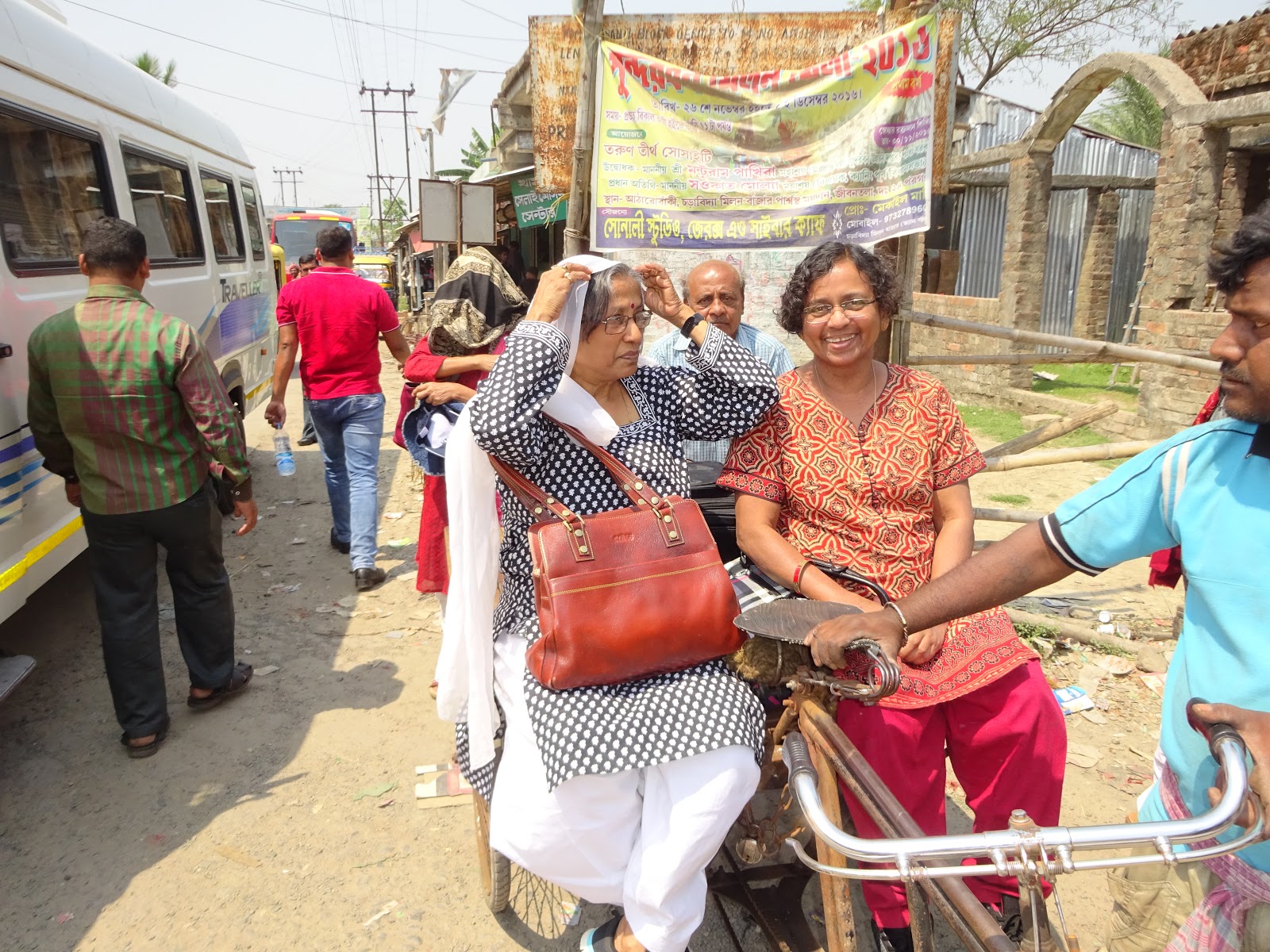
After what looked like a millennium, we travelled past Canning and through Basanti town reached Sonakjali after almost 4 hours. Here we had the unique experience of travelling, of course for a short distance, in a cycle rickshaw, like the ones in which goods are transported. This one transported humans as well!

From the jetty, we got into a motor boat and reached the Launch, by name Chitralekha, which was going to be our home for the next two days. The Launch launched us into Sundarbans, the thick mangrove forest, the largest in the world. The name Sundarbans means ‘beautiful forest; the name itself is said to have derived from a tree, called ‘Sundari,’ predominantly found in these forests.

The island-forests here have been formed as a delta or estuarine of the two major rivers, both arising from the Himalayas, Ganges and Brahmaputra, which join the sea at this place. The estuary that resulted is inundated with salt water, ebbing and flowing twice a day, due to the pull of the moon’s gravity, as high and low tides.  

The mangrove trees in these salty brackish waters have developed a unique way to survive by breathing air, through their special aerial or aerating roots that arise out of the water like spikes with holes called pneumatophores, through which they literally ‘breathe!’ The trees also have prop roots to anchor the tree in that clayey soil. Their leaves have special ability to excrete salt!

On the Indian side, Sundarbans occupy 4264 square kms and in Bangladesh, there is a spread of over 6087 sq.kms. There are 102 island on Indian side alone, 48 being forest islands.

As we moved in the waters, the beauty of Sundarbans spread before our eyes. Rivers, rivulets and creeks, and the mangrove trees, crisscrossing the area, as if we were in a huge maze formed by waters.

At the start, the rivers were full of waters, it being the high tide. By the evening, it was the low tide and the waters had receded exposing the wet clayey mud-flats and the supporting roots of the trees. We sailed through Gomdi river and got down the small motor boat to reach the bank Shudharnakhali in Pirkali jungle and climbed up the watch tower.

No luck, for the elusive Royal Bengal tiger was nowhere to be found. Only through the videos of the guide’s mobile phones could we see them, killing and carrying goats or a fisherman or two killed by the tigers on their prowl. Here tigers eat fish and crab, and swim very fast, climb trees, drink salty water and take its pray in broad daylight, special adaptations for the ecosystem in which they live. As of now there are only 130 or so tigers in this area. No chance of sighting them, unless one is extremely lucky and obviously, we were not!

Our second stop for the day was Sajnekhali, where there is a watch tower, crocodile pond, deer park and turtle pond with olive Ridley Sea Turtles. We did see an estuarine croc lazily lying at one edge of the pond, but no turtles. Monkeys were wandering around, so also red crabs putting forth their limb with claws. We saw a mother and baby spotted deer as well. A monitor lizard was lying hidden among plants and dry leaves.

Many birds were flying over our heads, white breasted kingfisher, pied kingfisher, plovers, egrets, grey shrike, bee-eater and Adjutant stork. Dusk was approaching and I took pictures of the setting sun turned into a red globe on flame and soon we returned.

Every time we had to climb down the Launch to get into the boat and on return to get out of the boat and climb up the Launch, our feeble knees wobbled and the staff had to literally haul us up and down. That was an experience!

We returned to our home, Chandraleka and settled down for a good dinner and a deep slumber rocked by the tiny waves, as it dropped anchor in the middle of Pirkhali river. Mira had booked the only cabin on the Launch with an attached bathroom for ourselves and the rest, some 30 odd tourists, had two tier compartments like those in the trains to themselves.

Early next morning we woke up to the chattering of birds and the Launch had already started to move. It was low tide once again and we saw the bare banks beneath the tree line. Still no tigers.

Morning exercise was to climb down and go to Dobanki and take a walk on the elevated ‘canopy’ path. Even the two wild boars, which used to frequent the place refused to show themselves to us, but wait, one of them came down briefly to drink water at the artificial sweet water pond constructed by the forest department and I clicked, though at a receding figure.

On the return journey, we sat on the front bow of the Launch and enjoyed surveying the far reaches of the rivers, especially the Panchamukhani river, where one can see five rivers branching off. A few fishing boats were lazily floating on the waters.


On to the jetty and then once more riding the cycle rickshaw, the AC coach through Canning town and to Sonarpur, where my friend’s driver was waiting. We were pleasantly tired and looked for a good night’s rest and onward journey the next day to visit Rabindranath Tagore’s Shantiniketan. 


 That and the Shanthiniketan bags are for the next blog. I have run out of space! 

Wednesday, 22 March 2017

Gandhi – what type of a family man was he?


We know Gandhi as ‘Mahatma,’ a ‘Great soul’ and the Father of the Nation of India. We ascribe freedom won from foreign yoke to him. He led the independence movement in India against the British, using non-cooperation, and non-violence, which influenced the world over.

The question is what was he as a husband to his wife Kasturba, as a father to his five children and to his grandchildren? Did he practice at home the democratic ideologies he learned from the British, which he used against them? Or was he a tyrant and impatient teacher and an insensitive human being to the emotional and other needs of his family? Did his family got subsumed in his passion for his ideologies?

Gandhi describes his early days in his autobiography. His violating vegetarianism creed of his family and eating beef to gain strength as a boy; repenting that sin and confessing to his father about the whole episode and seeking his pardon; his excessive sexual urge, which made him spend that night in bed with his young wife, when his father lay dying and feeling guilty about it for a long time thereafter and so on.[1]

What made me question Gandhi as a family man was the book I read recently, written by Neelima Dalmia Adhar, from the viewpoint of Kasturba, his wife.[2] It is then I realized that despite all the adulations he had received from all over the world as a Mahatma, to his own family he was a heartless tyrant, imposing his will on them, with little heed to how it could be affecting them.

Briefly to narrate a few incidents, he forced his wife, who had come from an orthodox family background, not only to clean her own toilet, but also those of his guests at the Ashram. It revolted her and she fought against such imposed discipline and service without much success. Gandhi had his way and the children watched the wretched fight between their parents, and it affected them, especially the eldest boy, Harilal.

He refused to give his children proper school education and forced on them his own education at home whenever he found time. The children were all inducted into the ashram life and duties one by one, without any education. Harilal resented this all his life, as he wanted to be a barrister like his father and wanted to be do his law course abroad just like his father had done.

Instead when an opportunity arose and a wealthy man offered to send one of the boys of Gandhi abroad for studies, Gandhi refused to give that privilege to his own eldest son Harilal, for he did not want to be seen as taking advantage of such an offer for his personal family and sent another boy related to him.

This broke the heart of Harilal and he left his father’s Ashram. Thereafter he became a vagabond and a drunkard and a useless man. He never forgave his father for what he did to him, not that Gandhi ever realised the harm he had done to his own sensitive son.

The next son Manilal also would feel the heat of the strict disciplinarian father. As a teenager Manilal had an infatuation for a young girl in the Ashram and was mesmerised by the long hair she had and had embraced her once after she got out of the pool where they were all bathing. When then next time he did it, it happened to be the wrong girl and the complaint went to the Ashram head, Gandhi.

After finding out what happened and the reason for his son’s infatuation, Gandhi not only ordered the beautiful long tresses of the two piteously crying girls to be chipped off mercilessly, but also forced a 12 year brahmacharya’s (to be a pure bachelor) vow on his helpless son and banished him to another Ashram far away from his present one. Manilal underwent the punishment for he couldn’t have gone out like his elder brother and suffer, for they were neither educated nor equipped to stand on their own to face the world.

Principle is good to hold, but it should be tempered with compassion, which Gandhi repeatedly refused to show on his own family. His own youth was plagued by sexual excesses and at the age of 45 he took the vow of brahmacharya, without the consent of his wife and partner Kasturba and thereafter the whole world, especially his own sons had to be strict brahmacharies (bachelors).

He had fathered five children in quick succession, but would talk ill of his elder son, who also gave birth to five children. Was there any understanding of human frailties? Not at all. He expected his sons of 18 and 25 years old to be what he was, when he was 45 years old. Unreasonable expectations.

Later when Manilal fell in love with a Muslim girl and wanted to marry her, the Father of the Nation, who spoke of integrated India, an India for both Muslim and Hindu, refused to give permission and made the son renounce his love.

On return to India, when ancestral property was to come to him, Gandhi stood on his principles and refused to take his share, which if he had accepted, would have helped his elder son, who was struggling financially in his life. The same Gandhi had no compunctions to accept hospitality from Birlas and other wealthy merchants, later in his public life. Where did the principle go that time?

Gandhi also tried very hard to make Kasturba literate and imposed lessons on her unwilling self, which ended abruptly when Kasturba put her foot down and refused to undergo this torture any longer.

Devdas, the fourth and youngest son of Gandhi fell in love with the daughter of C. Rajagopalachari, another famous leader of independence struggle, and Gandhi refused to give his blessings, because she was a Brahmin and Gandhi belonged to Baniya caste.
Finally, it was decided that both will wait for five years and even after that they felt they were in love, they can marry, which they did. So, Gandhi was never against caste system or worked towards its abolition, but wanted to preserve it as it was and imagined that Dalits would be safe within this rigid caste system, an unrealistic stand.

Lastly, a man who had excess of libido as a young man, and who gave up sex at the age of 45, taking a vow of brahmacharya, and expected strict morality from his sons, would undertake sex-experiments at the age of 60, to check whether his vow was truly being followed by him or not. And this was done publicly in front of the eyes of everyone, young and old, Indian and foreigner.

He would lie naked on his bed in the nights as he went to sleep, with two young girls lying on either side of him, both naked, to check if he had really realised his goal of brahmacharya or not. To his despair, he found that he had arousal and felt convicted that the problem the country faced was because he had failed in his brahmacharian vows.[3]    

Well, less said the better of this quirky little man, who is the Father of the Nation of India. Politically also many of his decisions delayed independence and led India towards partition and the subjugation of Dalits under the upper caste Hindus for a long time to come, even in the independent India.

The very fact that independence of India was won by him is disputable. Had it not been that the Indian army (British army of Indian soldiers) refusing to obey the British, after the three INA[4] leaders were hanged, independence would have been delayed still further.

So much for the Mahatma and the Father of the Nation.


[1] M.K. Gandhi, An Autobiography or The Story of My Experiments with Truth, Navajivan Trust, 1927.
[2] N.D. Adhar, The Secret Diary of Kasturba, Tranquebar Press, 2016.
[3] Claude Markovits, The Un-Gandhian Gandhi: The Life and Afterlife of the Mahatma, Permanent Black, 2003.
[4] Indian National Army of Subhas Chandra Bosh.

Sunday, 12 March 2017

“Bodhicatva” – A Cat that is Enlightened!


A play on the term Bodhisatva notwithstanding, have you ever heard of a talking cat, much less a writing cat? That is precisely what the Dalai Lama’s cat does. She has written a book, ‘The Dalai Lama’s Cat’ in first person! It is hilarious to say the least, but also very deeply philosophical.

A cat that absorbs all that Dalai Lama, the Buddhist religious leader of Tibet, says by way of discourse with his high-profile visitors and writes about her experiences of being the pet of Dalai Lama. At least that is how David Michie, the author of the book, would want us to believe.

The cat is rescued at birth by the kind Dalai Lama from the streets of New Delhi and brought up as a pet at his residence. She is a snow-white pedigree cat, though slightly crippled in a fall from the hands of the mischievous boys, who dropped her, while trying to sell her to make some money.

From the window sill of the Holiness Dalai Lama’s visitor’s room, the cat not only surveys the magnificent view of the snow-capped Himalayan mountains, but also gets to listen to the discourses that take place between Dalai Lama and his visitors.

Highly philosophical ideas like ‘you become aware that your true nature is one of boundless love and compassion,’ to all sentient beings including cockroaches, which also share with humans two basic wishes, ‘the wish to enjoy happiness and the wish to avoid suffering,’ the cat absorbs and reflects everything her master theologies. Of course, everyone wants to be loved as well.

The downside of being Dalai Lama’s pet, the cat soon would find out, was having to feel guilty on letting her instincts take the upper hand and caught a mouse in between her teeth. Considering her actions from the point of view of the mouse, it was a grave error in causing that sentient being to suffer. She gave up the prized catch and the mouse recovered much to the delight of everyone around in the household of Dalai Lama, the cat included.

With another visitor, the question arose whether living in nunnery is better than living in jail. The moral that emerged was ‘it is not the circumstances of our lives that make us happy or unhappy but the way we see them.’ Whatever the circumstances we have the chance to live happy and meaningful lives.

Dalai Lama discusses his singleness with an Italian chef, who is also single, to prove his point that being single need not be the cause of unhappiness. The cat leant a crucial lesson that the idea that she needed another cat to make her happy would be a source for her unhappiness, especially if she pursued it. True happiness resulted by giving happiness to others.

She becomes a celebrity at Café Franc, where the owner calls her the His Highness’ Cat (HHC in short), trying to get the maximum mileage for his café; the cat got royal treatment and pure delights of meat dishes which she relished. Both their karmas were getting on very well!

The visitors to the café were of course far from being enlightened. They missed the point of observing “mindfulness,” which is paying attention purely to the present moment and not dwelling on the thoughts of the past or the future. They were so engrossed in texting friends and relatives or reading, that they missed relishing and savouring their food, so carefully and tastefully prepared.

A very interesting visitor comes to meet Dalai Lama, one who has motivated many to improve their lives and in due course built an enormously successful self-development company in America, but it wasn’t working for him. His wealth and guru status were not helping him personally.

Dalai Lama helps him by pointing out that this dissatisfaction with the material world was good, for it will spur him onwards to his spiritual development. From self-development, he needed to work for others’ development. The man went back transformed, shifting the focus from ‘self’ to ‘others’ and very soon started a course in Other Development.

There is a long discourse on karma and karmic account, which left me totally confused. At least in Hinduism, the mother religion from which arose Buddhism and Jainism, the concept karma is clear; it is the accumulated deeds, good or bad, one did in the preceding many births, (one has to believe that such previous births were there, and I do not believe that), which has a direct effect on the status in life a person is born in the present birth. 

In Buddhism, this is not very clear. It is the law of cause and effect, and we create our karma by what we do. What we sow we reap. But Buddhism has borrowed the concept of many births from Hinduism and there everything goes awry. For Buddhism believes that there is no god to punish or reward and no cosmic computer keeps a record of all such deeds over many berths.

To a bewildered Western visitor, it is explained that it all happens in the continuum of our minds. Very helpful indeed!

Saying that Christ and Christianity believed in karma was very misleading, for Christian sowing and reaping is not with respect to many births and deaths; it is with regard to the one life we all have in this world and after death and final resurrection, inheriting eternal life or eternal death, based on our good deeds or bad deeds in this one life. It is a far call from Hindu or Buddhist concept of karma. Moreover Christians believe in a God who would judge all of us on the final day.  

One last episode that really impressed me was the case where a boy who wanted to go abroad to make good his dreams, was not doing it because his parents were objecting and they wanted him to get married and settle down instead. The monk who was advising him points out that these are mere excuses the boy is putting forth and the real impediment is his own fear, fear of failure. On realizing this the boy makes a dash and flies to the foreign land to fulfill his dreams.

A very useful contribution to one life indeed.

Well, there are nuggets of wisdom strewn throughout the book and it is quite a good attempt, especially as it is by a cat, that too a ‘Bodhicatva,’ full of compassion and love for other sentient beings.


Wish human beings would be more like that! 

Thursday, 2 March 2017

Is Truth Divisible?


Is truth divisible? Can there be parts of a truth? Can truth be seen from different perspectives? Is truth subjective? Or is truth indivisible and whole? Is truth objective and above human speculations? These are very difficult questions to answer. Philosophers have debated these since the time of Socrates and Aristotle. Sages have meditated on these questions in ancient India and elsewhere.

So, what is truth?

Truth is a fact or a reality. It is an objective reality. It is something that exists always without change. If truth is subject to change, then it would no longer be a truth.

Science can speculate about the origin of the universe, because it does not know it. Facts are not available that far back in time. Or the reasons of how and why the dinosaurs died en-masse. However, what we see as unchanging, the sun, moon and the stars, tell us the truth about these heavenly bodies and we base all our calculations on these unchangeable factors.

Certain things are above human perceptions and speculations. We need these solid things, because on their truth and regularity, different aspects of our lives are built around. Truth about these elements better be unchangeable, otherwise our lives will be in a mess!

Coming to truth about religion and God, there also different perspectives prevail. In Indian religions, Hinduism, Jainism or Buddhism, God is seen as relative and subjective. Each one can see one aspect of God and think that that is the truth about God. It is truth relativism. There are no absolute truth or values. Culture plays a major part in defining a truth and it changes according to cultural and social norms.

Subjective truth is a truth based on a person’s perspective, feelings and opinions. It can change much like a kaleidoscope. What I believe as truth is truth for me and you are welcome to have your own views about a truth. No conflicts and we coexist.

Due to this approach, In India, we have multifarious faiths and beliefs and gods. Anything and everything, both inanimate and animate, can be a god. What is the truth to one person need not be truth to another person. It is highly subjective. And all religions are accepted as parts of the same truth. Rig Vedic hymn says, “Truth is One, though the sages tell it variously.” It is a polytheistic approach.

Christianity and the other monotheistic religion, Judaism, teach differently. Truth about God does not change; it is irreplaceable and unchangeable; and because of these characteristics, that Truth is dependable. If truth about God keeps changing, then we have no solid ground to tread on.

Jesus said, “God is Spirit, and those who worship Him must worship in spirit and truth.” John 4:24. For true worshippers will worship the Father, (God), in spirit and truth for Father is seeking such to worship Him. Jesus further proclaimed that “I am the way and the truth and the life.  No one comes to the Father, except through me.” John 14:6.

God, whom Jesus called Father, is truth and He expects those who worship Him to worship him in truth as well. Jesus said he is the truth. And further he said, whoever abides in Jesus will know the truth and the truth shall set him or her free. John 8:31-32.
What we see here is the solid ground of truth on which human beings can stand and be free. 

Truth does not change. It is that what has always has been and always will be. “Jesus Christ is the same yesterday and today and forever.” Hebrew 13:8. That is solid ground, a good foundation for us to build our lives on.

In Postmodernism, which happened to the Western philosophy in the twentieth century, a general sense of scepticism creeped in and everything including reason was looked upon as suspect. The result, absolute truth lost its hold and relativism and subjectivism took its place. On the ground it is reflected in the chaos that prevails in the Western countries today.

Order to disorder, unity to divisions, peace to anarchy, and so on till there are no more values worth dying for or fighting for. It is the chaotic situation in the East that has been transported to the West. The reason being there is no solid point of reference for God and Truth.

Let me reiterate again, truth cannot be divisible or changeable. It is solid and abides for ever. That is why it is truth. It is not subjective and is above human speculations.

God is Truth and is the same always. That is His characteristic attribute. So says the Bible, the revealed word of God. We will not know that about God, unless He Himself has revealed it to us through His word.


Jesus is the Truth, so said the Son of God, who represented God and His divine attributes in person, when he walked the earth as a human. John 1:14. So we are able to go to him in faith and confidence and obtain eternal life. 1 John 5:20. That is the unshakable truth indeed.