Saturday, 23 September 2017

Santorini, Here I Come!


A small but beautiful island lying in the southern Aegean sea, some 200 kms southeast of Greece mainland, is Santorini, a member of Cyclades group of islands. My friend and me after landing in Athens on the eventful day of 14th September 2017, went exploring the island. 

The cruise, Champion Jet 1, in which we traveled had many sections, including platinum class, club class and of course the economy class. There were restaurants inside the cruise, which served lovely food and snacks and drinks, that people of all classes enjoyed gorging themselves with these fare. The cruise left at 7 am on 15th September and after five hours of flawless journey reached Fira, capital of Santorini, and was docked at its principal port Athinios.

The Ship 'Champion Jet 1' in which we traveled, 
docked at Athinios port in Fera.


On the way it stopped at islands Mykonos and Naxos and gathered many more tourists into its belly. The cruise was so big it could accommodate 950 people and many cars and twowheelers.   

Interior seating of the cruise


Sunrise over the sea waters, captured from                                                   inside the cruise

A small vessel sailing by in the quiet Aegean                         waters

We booked ourselves into the hotel Astir Thira on arrival and immediately after lunch I got out to go and visit Akrotiri, situated at the south end of Santorini, where ruins of old Minoan civilization have been dug up by the archaeologists. Minoan civilization flourished some 3600 years ago, and was destroyed in a volcanic eruption that flattened the town around 1645-1600 BC. The tsunami waves raised during this quake were so huge that these reached the nearby island Crete and destroyed the Minoan civilization totally. Remains of this once great civilization have been unearthed, showing houses three storied high and walls painted with frescoes with their colors intact. 

                                                                                 
                                                                                  Hotel Astir Thira, Fira, where we stayed 


A Greek Orthodox church 

The island is full of Greek Orthodox churches and just one Catholic church. Typically these churches have a dome with a cross, the dome characteristically painted turquoise blue, which literally gleam in the sun. Some 352 such churches are found all over Santorini. The name itself seems to have derived from St. Irene, the patron saint of the island. 


View from the Hotel of the volcanic rocks and a ship 


  Taxi motorbike common on the streets of Fira
                                                                                        
Tourism is the main stay of the island, along with some agriculture and wine-making. The population of Santorini is only 15,550 as per 2011 census, but it looked as if the tourists outnumbered the locals! Many work in the island for seven months, when tourism is on and then go back to their homes in Athens or elsewhere during the off-season. 

On return from the Red beach of Acrotiri, we embarked a bus to the village Oia, pronounced amusingly as Eeyaa, which lies on the northern tip of the island. This is the oldest settlement on the island, full of beautiful houses, white washed and borders painted with turquoise blue and churches gleaming with turquoise blue domes. The narrow village streets are maneuvered with donkeys, which are used as transportation and also for carrying goods. 


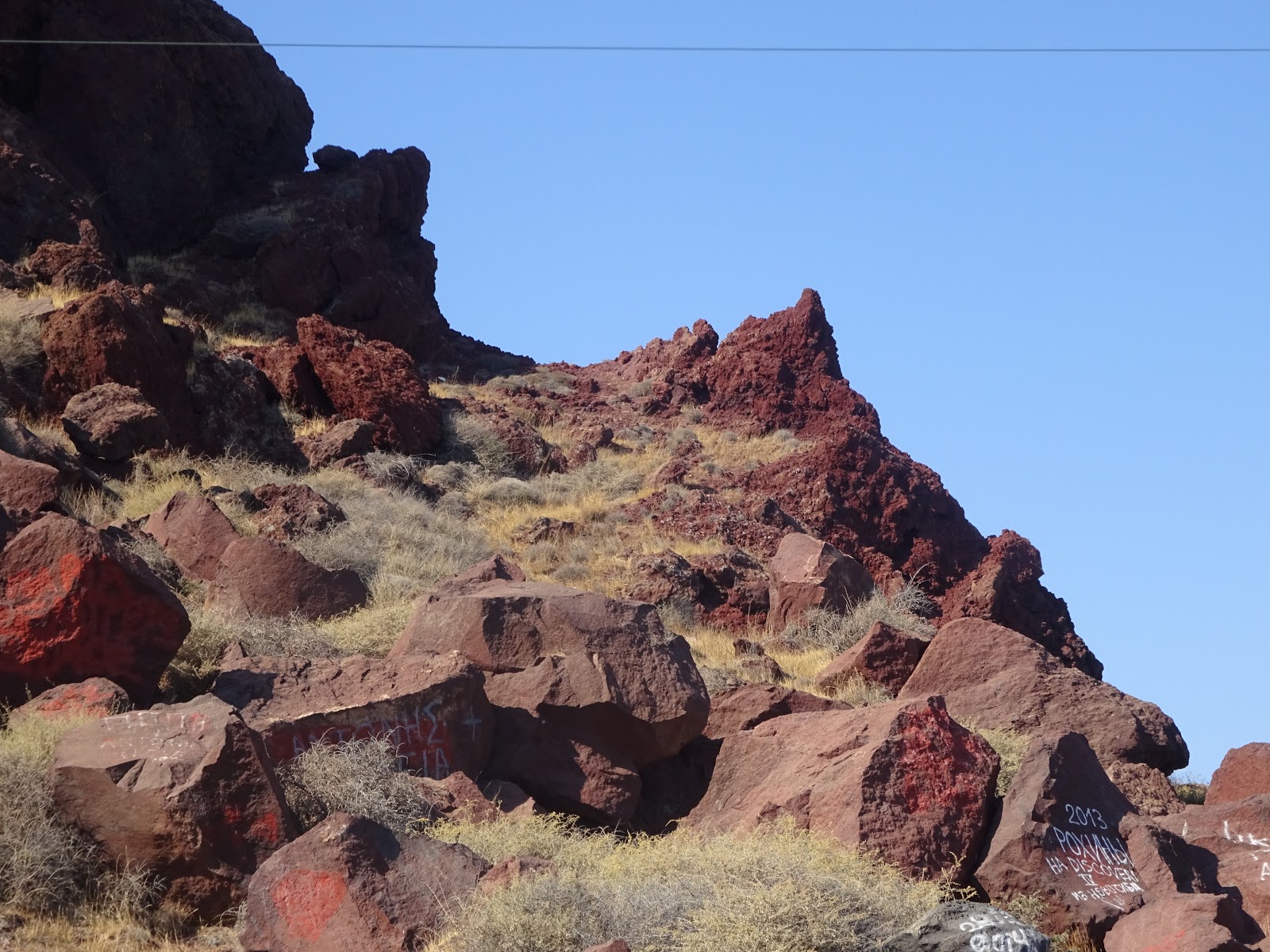
 The red volcanic rocks and the Red beach of
 Acrotiri


Terrace restaurant at Oia


We went up the terrace of a house, which doubled up as a restaurant, had for our supper, the fabulous Greek food of five dips, sipping 
our drinks, soft drinks strictly, as the sun went down slowly bathing the whole sky, including the buildings and the church, a beautiful red. 


                                                                                          Church in Oia, bathed in the setting sun.


Pleasantly tired and satisfied in having seen this beautiful island Santorini, we returned to our room, thanking God for this great opportunity to see such serene places and slept off to start another adventure the next day.

If you liked this account, do wait for the next installment!

Saturday, 26 August 2017

Nandi Hills, Comes Calling Once Again!


This year, within the last 3 or 4 months, I have visited Nandi Hills three times! What is with Nandi hills and me! I really do not know! But this time it was at the foot hills of Nandi Hills and it was for a church retreat.

Adonai church at Cox town had organised a week long “Healing and Deliverance ministry.” It was at Glorious Promised Land, a few acres spread at the foot hills. Lovely place, with lovely fruit bearing trees and plants; place brimming with fig trees and fig fruits hanging from the stems and branches! There were other fruits too, of course, forbidden to pluck and eat!

There was a mini zoo too, with a beautiful black cocker spaniel, reminding me of my own Sally and Cindy, mother and daughter pair, jet black and so loving, but passed off with five years apart. There were goats, ducks, geese and turkey birds! Well, I missed seeing the bunny rabbits, which were also somewhere in the premises.

To be fair, the proprietors of the property, rent out this beautiful place mainly to Christian organisations, who want to hold conferences, workshops, retreats and camps. Also for weddings, family gatherings, picnics, concerts and meditation camps, but strictly Christian.

Isn’t that beautiful! Who even bothers about Christians these days in this country, except to admonish that one is a ‘rice Christian,’ or a ‘chocolate Christian,’ and to force ‘gar vapasi’ on them! Of course, not everyone says that. Still the ruling elite and the village level workers of the governing party say that! That is bad enough.  

Moreover, the proprietor and his sweet wife, both stood personally at the food counters and served the food with lot of concern. They, I think, have taken this as their personal ministry to the Lord. How wonderful! Oh, before I forget, we got chicken every day! And on the last day chicken and beef biriyani too!

Well, coming back to the ministry by Adonai church, the Senior Pastor Victor was there full time, so also his wife Mrs. Annie Victor, both together admirably conducting the classes, starting from Saturday the 12th to the next Saturday, the 19th August 2017. There were others from their church to help them with praise and worship, the devotionals and music.

They taught about the foundations of the healing ministry, the creation and the Fall, God’s solution to the situation and the model of healing as shown by Jesus on his earthly ministry. Promises of God became reality on earth as man agreed with God in faith.

The next session was to introduce the concept of man being created whole, with soul, body and the spirit, an undivided and unbroken completeness, to engage in a fruitful relationship with God the Creator. Man lost it all due to disobedience and in the consequent Fall, lost the connection between him and God, which was though his spirit. This must be restored. That is all what healing is about, bringing in restoration in the relationship with God.   

Soul consists of the will, emotions and the mind. Here is where all the decisions are made and executed by man. He thinks, decides and feels. Right now, all these are in disarray. How to bring these in alignment with God and His will, is what will bring back restoration and healing.

There were lot of practical examples through during the lectures and there was plenty of humour, especially in Pastor Victor’s classes. One enjoyed it all. Many a times the whole class roared with laughter at his antics! 

Rejection and the cure for it, acceptance, especially by God, who loves us so much that He went to the cross for saving us, were taught beautifully. The unconditional love shown by the heavenly Father is what would really heal our rejection from our earthly families.

Importance of forgiveness, letting go of those who had hurt us, were emphasized in the class. When we are not able to forgive, it not only festers inside us, leading to bitterness and diseases, but also leads us being critical and judgmental about others and the world in general. It is in our own good that we forgive and release such resentments.

Dealing with emotional pain was another of the topics given importance to. Belief systems, the need to have right beliefs in our minds, relationships and soul-ties, were all beautifully expounded. Root causes of fear and overcoming fear were taught with examples from the Scripture and everyday life.

Blessings and curses, dealing with supernatural realms, restoring the human spirit, how we give access to demons to play havoc in our lives, were all taught with many examples and biblical quotations.

All these teachings opened a new vista and one understood many issues related to the spiritual realm; how to get close to the Lord and how to safeguard ourselves from negative forces in the world and how to get relief from such oppression, if one is suffering from it – all these were real minefields, full of information and practical examples and testimonies after each of such topics.

It was wonderful to have attended this school for eight days. There were 170 participants. Many had come with small children, husbands and wives, parents, mother and daughters, and so on. Some had come from Dubai, Doha, even Ghana, Africa! There were 15 children, some of them just babies, still parents had braved the difficulties to come and attend the classes.

The topping of the cake was the two days kept for individual ministry. Everyone had a one-to-one ministry time with two of the very experienced ministry team that had come specially for the purpose on the last two days. There were 20 such ministry teams and all were attended to, some of them twice or thrice even.  

While a person was being ministered to by these teams, the other participants spent their time in praying for those who were being ministered unto, and wrote down the messages or Bible verses that came to their minds in cards, which were given later to the persons concerned. Well, these are to be treasured for ever. What words of encouragement and solace!

On the whole, it was a beautiful experience. I personally had a lot of time to introspect and bring out many of my faults, which needed rectification and unconfessed sins, which were brought to memory during the sessions. Almost everyone walked out with huge burdens lifted off the shoulders. Many healings and deliverances happened. Praise be to God alone!

Yes, it was worth attending this retreat. In case you are interested, do contact Adonai Church, 080 2548 3335. I am sure you will get more benefit from it than you think you will!


God bless you abundantly! 

Tuesday, 8 August 2017

Homer and His World!


It is not easy to write on Homer! He is, after all, a great poet of ancient Greece, who wrote two great epic poems, The Iliad and The Odyssey. He might have lived around 700 BC. Recently I started to read the Odyssey, just for want of doing anything else, a book I had bought in 1975 and might have read it that time!

Basically, I reread Odyssey. The theme is the famed Trojan war and its aftermath. Paris, one of the sons of Priam, the king of Troy, had abducted the beautiful Helen, wife of Meneclaus, the ruler of Sparta.

Under the leadership of Agamemnon, the Greek overlord and the brother of Meneclaus, Greek princes, set sail with thousand ships, siege Troy for 10 years and finally contrived the Trojan horse, with which they tricked the leaders of Troy, entered the city and sacked it. Helen was retrieved and the story of Iliad ends there.

Now the story of Odysseus, king of Ithaca and a hero of the war continues, who for the next ten years was driven hither and thither by a series of mishaps, on his return journey to his home, Ithaca. That is Odyssey!

The story is interesting, apart from the historical narration of epic proportions, for the insight into the habits and beliefs of the people of Achaea in that hoary past. The terms Greece or Hellas (Hellenes) were not in usage then, but to Homer they were Achaeans.
First thing to note is how in Homer’s time, people, especially the Achaeans, (latter Greeks) believed that gods in heavens were responsible for the good things or bad things that happened to them. They were either favored by a god or goddess and led to good pastures or having earned the wrath of a god or goddess, repeatedly were subjected to tragedies and difficult times.

Gods were responsible to whatever happened to the humans, was the important belief of the then Greeks. The leader of the Olympian gods was Zeus. He had three wives, including his own sister. Aphrodite, Artemis and Athene were his daughters. Apollo, Ares (Mars), Hermes (Mercury) and Vulcan were his sons. Zeus also had two brothers, Hades, ruling the underworld of the dead and Poseidon, ruling the waves.

Imagine gods having sons and daughters, that too from different wives! Well, to please them and not to incur their wrath, the Greeks offered many sacrifices, of bulls, goats, and lambs. Wine libations were poured out at their altars. Thigh of the sacrificial victim, wrapped in folds of fat was offered to the gods, blood of the victim was collected and offered to the heavens. Thereafter the people and the princes ate the remaining.

They believed on omens, birds, eagles, doves and others as sent by the gods, to indicate good or bad happenings to the humans.

And then men wept, copiously, for their dead, in remembrance of their lost homes, wives and friends and over their misfortunes. Wonder where the stiff upper lip of the English and the modern-day adage that ‘boys do not cry,’ came from!
  
When men of royal birth or a distinguished visitor came to a place, they were given bath by the maidservants. After bathing them, they were rubbed with olive oil, and given tunic to wear and fine cloak round their shoulders. They stepped out of the bath looking like the immortal gods! Wow! This expression occurs many times in the narrative.

When guests were seated for banquet, they were seated in high chairs, and a maid came with water in golden vessel and poured it out over a silver basin so that they can rinse their hands before eating the food.

The maid servants also drew a wooden table to their side, for the house keeper to bring some bread and set it by them with a choice of delicacies. Meanwhile a carver dished out for them on platters slices of various meats, like oxen, pigs and lambs and put golden cups beside them. Then the guests fell to eating!

Most striking thing is that Helen, whose face launched a thousand ships, and the reason for the destruction of Troy, and the loss of the lives of many warriors, was living happily with her husband Menaclaus, her small indiscretion of having run away with a Trojan prince not withstanding! Hmm, weird are the ways of men and women!

The games which took place in every city with events like running, javelin throw, disc throw, boxing, wrestling, jumping are the pointers to modern Olympics, and as such are fascinating.

It is interesting to read about the land of Lotus-eaters, where one forgets everything; the one-eyed monster Cyclops, who ate up some of Odysseus’ men; Calypso, who had kept Odysseus captive for a full 9 years, trying to entice him into marrying her; Circe, who transformed his men into pigs and penned them in pigsties;

Odysseus climbing down into Hades, where the dead souls were left to languish, to obtain oracles; the terrible monster Scylla, who fished his men with her six long necks and devoured them; Charybdis who sucks sea water and spews them out three times a day, Odysseus encountered them all during his voyage back home to Ithaca.

Finally, he reached home only to find several young men courting his wife Penelope, but who faithfully waits for his return and his young son Telemachus, who not able to handle these suitors, was waiting for his father’s return. Skilfully, Odysseus, with much help from his patron-goddess Athene, fights and destroys the suitors and gets reunited with his wife. Bravo!

A very interesting story of gripping events and imaginations describing the return journey of Odysseus. Worth reading at least once in one’s life time!


Wednesday, 19 July 2017

The Birth of the Problem in the Modern Middle East


Middle East has always intrigued me, not only because it is always in the news today, especially for the violence that is bred there. May be the fascination is because of Israel, a country that was carved out of Palestine in 1948, very much close to the partition and independence of India which happened in 1947. A home for a homeless people!

The Jews lost their home twice, once when the Babylonian king Nebuchadnezzar conquered them finally in 586 BC and took the people captive. The Babylonians razed the City of David, destroyed their Temple on Mount Zion, destroyed their city Jerusalem and left it forlorn and deserted. Prophets Jeremiah and Zephaniah were active during these troubled years.

After 70 years of exile, the Israelite were permitted to go back to their country and rebuild their Temple, during the reign of Cyrus, the King Persia, who overruled the Babylonian kingdom in 539 BC. The exiles returned under Nehemiah and Ezra.

These events were all predicted by the Prophets of Yahweh, God of Israel and happened exactly as it was foretold. Prophets Haggai and Zachariah encouraged the returned exiles to rebuild their city and the Temple, which was done, though in a much smaller scale when compared to the first Temple build by King Solomon.

King Herod enlarged and beautified the Temple and made it a marvel and pride of Israelite. Then came the birth, crucifixion and resurrection of Jesus Christ, who prophesied that the Temple will be destroyed with not one stone resting on another. This happened in 70 AD, when Roman army invaded Jerusalem and his commander Titus, destroyed the Temple and the city Jerusalem completely and sent the Jews scurrying all over the world.

For the next almost 2000 years the Jews lived as exiles in different countries, persecuted, isolated and treated as second class citizens, especially in Russia, where they were in large numbers. But in their hearts the flame always burnt that one day they will return to their land, the Land promised by their God to their forefathers, Abraham, Isaac and Jacob. This has been foretold in Bible by many prophets. And the Jews awaited that day of return.

The seeds were planted after the First World War (WWI), when the mighty Ottoman Empire tottered and fell to pieces. The then reigning British Empire inherited most of the Arab peopled-lands after the war.

Britain acquired 200,000 square miles of additional territory, and ruled from Egypt and Iran, which were with her earlier, to Palestine, Iraq and Jordan. This was seven times bigger than the Roman Empire at its helm. The League of Nations gave the Mandate for these broken pieces of Ottoman Empire to the victorious nations, the British and French. Syria and Lebanon fell to the lot of France.

Britain made a few promises during that time, including the Belfast Declaration, promising a home land to the Israel. This promise to establish a Jewish homeland in Palestine, a land with Arab majority, seems to have birthed not only Israel, but also the Middle East conflicts that we witness even today, including the growth of terrorism.

How did the Belfast Declaration come to be? It transpires that in 1915, Lloyd George, the then Chairman of Munitions War Committee, Britain, noticed with concern the shortage of acetone, a crucial element in manufacture of cordite, necessary for weapons. A Jewish chemist Weizmann, produced synthetically and supplied acetone, which was crucial in Britain winning the war.

As a reward for the great services rendered, Weizmann was asked what he would like the British government to do in return. He asked for a national home for Jews in Palestine and it was assured to him.[1] It was a reward given to Weizmann, a Zionist, when Lloyd George became the Prime Minister of Britain.

Balfour was the First Lord and Weizmann became technical adviser to the Admiralty in relation to acetone supplies in 1915. It was Balfour who played a crucial role in the whole matter. That the dispersed Jews must have a home land was supported by the successful allied powers after WWI, America, Italy, France and Britain. Britain took the lead because Palestine mandate fell to her lot.

The promise of a national home to the Jews, known later as the Balfour Declaration, was contained in a letter written by the then foreign Secretary Arthur Balfour to the leader of the British Jewish community, dated 2 November 1917, which was later incorporated into the British Mandate.

Trouble started immediately as the local population in Palestine consisted of 90% Muslims and some Christians. Though the Declaration said that the home for Jews will be carved out without prejudice to the civil and religious rights of the existing non-Jewish population in the area, inter community conflicts started from 1920.

These conflicts became so severe that Britain could not manage its Mandate, surrendered it and had to leave in disgrace in 1948. Palestine problem became that of the world.

Balfour declaration, entered into in good faith to help the dispersed Jewish people, ended as a monumental failure, not just because of the mismanagement of the British authorities, but also because of the hardening of the hearts of the surrounding Arabs. The Declaration itself did not commit Israel-Arab conflict. They chose that conflict themselves.  

This need not have been, for the Zionists offered areas of autonomy within Palestine for the Arabs and economic concessions to the Arabs, in the early years itself. Palestine could have developed to the benefit of both the communities. But the Arabs were uncompromising, they would not agree to a Jewish homeland at all. This obduracy, in my opinion is the major reason for the conflict in the area.

Ever since the stand of the Palestine Arabs and other Arab nations surrounding Jewish Israel had been that the Jewish nation has no right to existence and that it should be exterminated. Ever war that followed between Israel and the surrounding Arab neighbors only enhanced the area of control by Israel.

What would be the end? We do not know. Two-nation Palestine? We are not sure.

Any divide and rule strategy would back fire. In India itself, what was partitioned in 1947, has caused three wars between India and Pakistan and continued interference and troubles in India-held Kashmir.

With Pakistan becoming a training land for the terrorists with American largesse, and China cultivating the friendship of Pakistan, India has more troubles to face on its borders in the coming years.

So also in Palestine.


[1] Walter Reid, “Empire of Sand: How Britain made the Middle East,” Birlinn-Edinburgh, UK, pp.93-94.

Wednesday, 28 June 2017

Slaves, Slave-Masters and Slave-Catchers: The Gory details of Slavery in America


Coloured American, Colson Whitehead, has written a book “Underground Railroad,” which won Pulitzer Prize for fiction in 2017. This made me eager to read the book, so I bought a copy and started to read it. It is the story of a Negro girl named Cora, a third-generation slave in the cotton plantation in the south America, Georgia, in the 19th century, pre-Civil War times.

Cora’s grandmother was kidnapped and sold to the plantations; the whole family was sold, and she was bought for $ 226 and sold and resold many times in the next few years. Slaves of breeding age were in demand, with the hope they will squeeze out children like pups, for ‘money bred money.’ Finally, she landed in Georgia.

She took husbands three times, only to lose them all to resale, cholera and death. Of the five children she bore, all except one girl, Mabel, died. Mabel escaped from the plantation and disappeared without a trace, leaving her daughter Cora at the age of eleven, an orphan, rather a ‘stray,’ like a dog on the street.

The story is about Cora, who defends her small patch, where she grew yams and okra, like her mother, the only property she ever owned. Girls were raped, violated on their marriage night by the master, and whipped to take away any trace of rebellion. The sadist owners invented every day new ways of punishing the slaves.

A slave is the property of her master who purchased her/him. There is no escape, for even a runaway slave, when caught had to be returned to the master as per the then prevailing rules of the States. Slave catchers were turned on these runaway slaves, until they were caught.

One such slave escaped, was caught and returned to his master in the plantation Cora worked. He was doused with oil and roasted alive in the full view of the white owner and his guests and visitors, who had their supper watching the free show in the front lawn. The victim’s mouth was sewn to stifle the screams.

Another inmate Caesar, invites Cora to escape with him. They escape and reach the underground railroad, a subway system that ran throughout the South that transported runaway slaves to the north, which was free. Though imaginary, there did exist a network of secret routes and safe houses that evolved in the 19th century America.

Their first stop takes them to South Carolina. Government owned the former slaves and rehabilitated them in decent works, provided them with medical care and communal housing. Cora and Caesar thought they had found a safe haven and stayed there for two years. She even worked as a live exhibit of a Negro slave in the Museum of Natural Wonders in S. Carolina.

Soon they found out that the government was preparing a state-solution for the problem of Negro race in America, by sterilizing the black women and using the male Negroes as subjects in their experiment to track the spread of syphilis. Moreover Ridgeway, the slave-catcher was after them and soon caught up with them at South Carolina.

In the melee of escape, Caesar got killed and she runs off to the underground station alone. Her trip brings her to North Carolina this time. Martin, the son of the station’s former operator, takes her home and hides her in the attic, where she stayed for several months.

Through a small hole in the wall, Cora watched the goings on of the nearby park. The servant of the house tells on the owner and raiders along with Ridgeway come home and take her, while her protectors were harassed and hanged. She was being taken to Georgia, via Tennessee, where a black-freed slave, Royal, notices her and with his gang attacks the slave-catcher and frees Cora.

They move to Indiana to a farm owned by a free black man, Valentine farm, and try to settle in. Soon word spread that the farm is harbouring runaway slaves and the White Indiana folks attack and burn down the farm. Many died, including Royal.

Ridgeway recaptures Cora, but insists that she shows him the underground rail station. She takes him, but kicks him down the stairs and escapes. She finds a cavern travelling West, and was given a ride by a coloured driver. There the story ends.

The book shows the reality of the brutal slave system and the travails of the slaves in the 19th century. The author has researched well, especially by going through the narratives of the old slaves, who were still living in 1930s, when the government chronicled them.

He had taken 16 years to mull through the subject before writing it down, a story which very well could have been his own ancestors’. A sad commentary on American ideals of freedom, liberty and fraternity, the values extended only to a Whiteman, but denied to the Black.

America was founded on Christian values, but sadly these were missing in their treatment of the black man, who were also created by God in His image. They were treated as animals with no rights of their own. And the Whites felt that it was their right to own not only the land, but also enslave others, a God-given right.

The author through the words of a character in Valentine farm states that, “This nation (America) shouldn’t exist, if there is any justice in the world, for its foundations are murder, theft, and cruelty. Yet here we are.” Just the opposite of what America professes.

But maybe, America is also the only nation that went to war against its own people to abolish slavery.


It is a paradox.

Friday, 16 June 2017

Kokkaraibelluru - A Village of Birds!


Have you heard of this place, Kokkeraibelluru? You might not have! It is 90 kms from Bangalore on Mysore road and 7 kms before reaching Maddur, you take a left turn and travel another 13 kms and there you are, at Kokkaraibelluru.

It is basically a small village, where every year by September-October hundreds of birds come to roost, raise their young ones, feed them with fish from the nearby ponds and leave just before monsoon starts in May.

‘Kokkerai’ in Kannada means stork; ‘bellu’ is white and ‘uru’ is village. It is the village of white stork. Most of the birds are Painted Storks and they have snow white plumage. Their scientific name, if you would care to know, is Ibis leucocephalus. Along with them lot of spot-billed pelicans and other smaller birds, including Cormorants also nest here.

Painted storks have been declared as endangered species of birds and this village is one of the 21 breeding sites in India. There are a few tanks or ponds near by the village, Tailur kere (kere means pond or tank in Kannada), Maddur kere, and Sole kere, which provide the fish feed for the birds.

The birds nest in the tall trees of tamarind and ficus in the village, but have free access to the village homes and their back yards. The birds and the villagers have co-existed harmoniously for decades in this village. The birds are said to return to the same nest year after year.  

Some 15 years back I had gone to the village once and I returned with wonderful images of the big birds sitting on the rooftops of houses and huts in the village, with the house owners and their friends sitting right below them and chatting. It was as if these birds were their friends or visitors who had come visiting!

I heard that the villagers do not harm these birds and they welcome them as seasonal visitors who stay for 4-6 months around their houses. The villagers believe that these birds bring good luck and prosperity to the village. They also get to collect some bird droppings, guano, which serve them as manure for their nearby agricultural fields.

There was even a small enclosure to treat the sick and wounded birds and forest department kept an eye on them. The department also pays the villagers small compensation for any damage to their trees or loss of tamarind harvest.

This year it suddenly occurred to me that I must go and visit the birds in the village. So, in the first week of June, I rented a cab and hurried to the place for I knew that the season was ending. When I reached the village, to my dismay I found that the birds had indeed left, but I did get to see some stragglers on the tree tops and a few taking lazy walks behind the houses.

They were big birds. I was happy to get to see at least some of them. The villagers grieved that this year because of the continuous and severe summer temperatures, the nearby ponds had dried up and the birds left early. There were a lot of casualty too. That was sad indeed.

After walking around the village and taking pictures of the lazily walking birds, and those sitting on the top of the trees, I returned, not before halting at a nice restaurant on the way back to feast on the famous Maddur Vada and a nice and strong cup of coffee.

Hmm, it was worth it. So, guys and gals living near Bangalore and Mysore, make it a point to visit this hidden place to view these amazing birds. Just go early in the season, so mark your calendars, October to May 2018! February to April could be the best season to visit them though.


 A wounded Stork near the water tank of a house


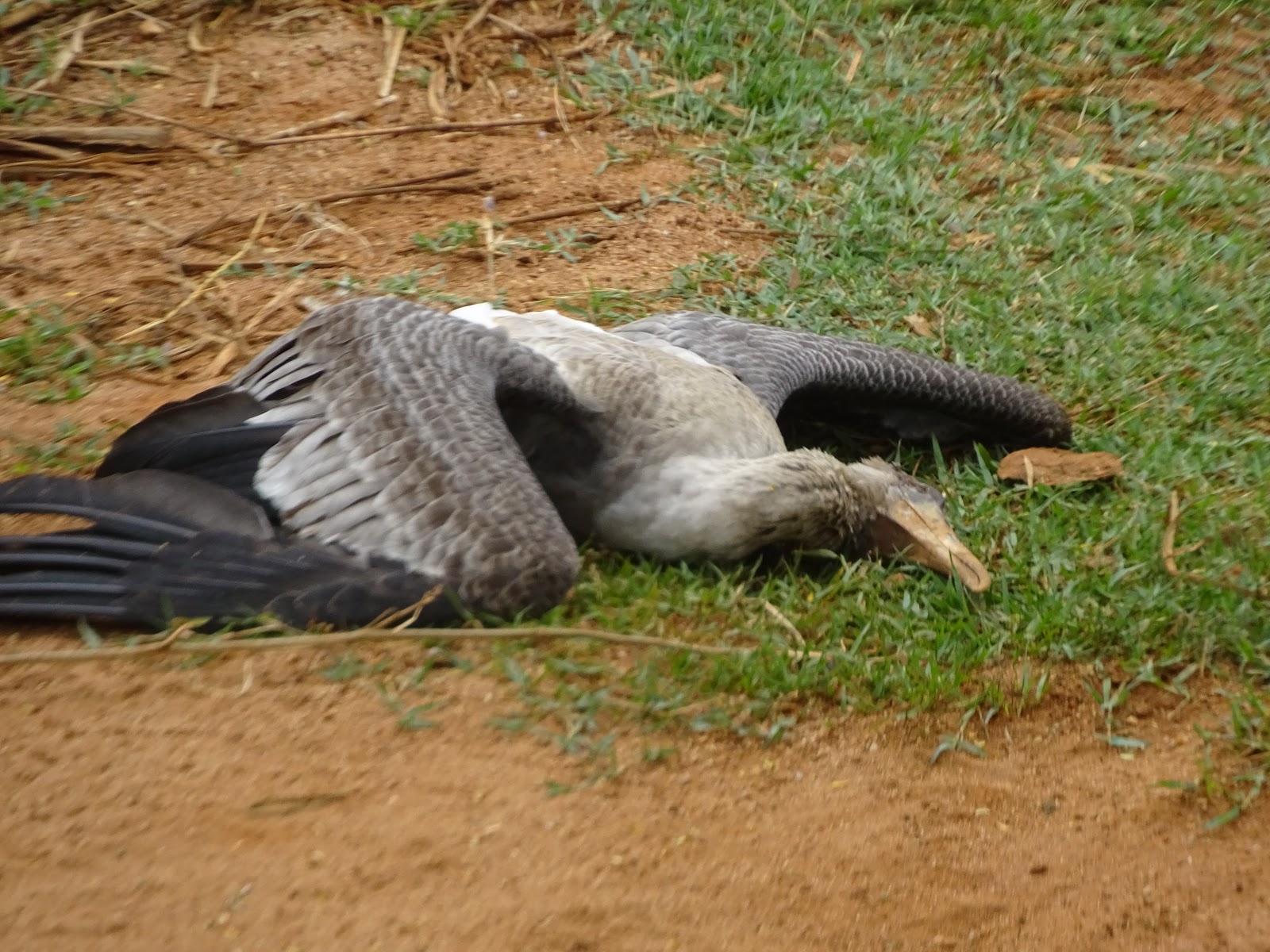
A dead stork lying around


 Village buffaloes!


A cute little kid in the village


Happy bird watching! 

Thursday, 1 June 2017

What’s with Nandi Hills and its Charm?


What is it that makes a person visit Nandi hills twice in a month? That is what I did. A week back I had gone there with my Christian Fellowship group members and had a wonderful time. Then again last weekend I was there  with my brother and his wife.

Is it because we have no other place to go nearby Bangalore? Or is it because this is the nearest hill station of sorts to Bangalore, so one goes there in summer, to cool off the scorching heat, just before monsoon strikes Kerala coast? I wonder.

But then as we drove past the International Airport, Bangalore, the charm started to work on. On the sides of the broad and smooth road people were selling jack fruits and grape fruits. I made a mental note of it, to buy some on the way back! The drive is just 57 kms from Bangalore.

As we turned on to the small road leading to Nandi Durg (Fortress), one could see vineyards on both the sides. People were selling grapes on the road. Many new resorts were coming up on the sides. As the driver lunged on the mountain road with curves, we got a panoramic view of the hills around and the lands under cultivation.

Managing the last few curves we entered the first arched entrance of the fort. The buses stop inside this entrance. Cars can buy a ticket for Rs.100 and go still further. A bus seems to come every day at 7am and disgorge its travellers and returns at 7 pm to gather the revellers back into its stomach. There are other buses too.

We reached the top around 6 pm. The place was full of cars and people. Not to mention the Rhesus monkeys, which seem very comfortable with the tourists.  Not that tourists are comfortable with them, prowling around, ready to snatch anything from the hands and mouths of unwary tourists.

On the very top is the Nehru Nilaya, a government tourist home and we had booked a room over there for a neat sum of Rs. 2245 per night. It is a beautiful colonial building with high ceilings and wooden rafts on the ceilings along with tall arched windows.

This bungalow was built in 1850s as the summer residence of Sir. Mark Cubbon, KCB, the then Commissioner of Bangalore. Long corridors and two huge dining halls skirted by four comfortable suites are in the first floor. There are rooms in the ground floor too and a flight of stairs lead up to the first floor, with potted plants on both the sides.

History of Nandi hills goes back to 1791, when this fortress belonging to Tipu Sultan, the ruler of Mysore, was stormed and captured by the British forces under Cornwallis. Thereafter it became a British legacy, now to be turned into a guest house and a tourist attraction maintained by the Horticulture department of Government of Karnataka.

The temple architecture on the top of the mountain is typical of Chola period and is possible that the hill was famous even before Tipu build a fortress there.

As we slowly walked around the place, absorbing the historical facts as well as the beauty of the nature around, we realised that this hill is at 1478 m (4851 ft) above the sea level and is made of monolithic mass of granite.

From below the Hills look like a sleeping bull and maybe, it got its name from that. Or it could be because of the Temple of Yoga Nandeeshwara which is at the top.

The Office of the Special Officer, Nandi hills is on the top, very close to Nehru Nilaya, and there are path ways leading to his office from many places around the summit of the hill. Enter any one and walk the path of thick and not so thick trees and bushes, you are sure to reach the office of the Special Officer. There is no way you can get lost on the mountains!

Illustrious people like Nehru, Gandhi, Queen Elizabeth II, have stayed in this beautiful bungalow. SAARC summit meeting was held here in 1986. Of course, today you and me can stay there for a price! That is the beauty of democracy!

Before it was seven pm, watchmen with whistles were alerting people and cars to leave the premises. Fear of accidents, suicides and unruly behaviour make these precautionary steps necessary, I suppose.

After a nice meal and rest, we woke up early to the howling of winds. On stepping onto the front balcony of the bungalow, one could see the amazing sight of clouds travelling so low that you could almost touch them and feel them. The trees around were bending and swaying in the wind, and cool breeze blowing relentlessly across one’s face. It was a marvellous experience.

We thanked God for the beautiful creation of His and for giving us this enjoyable time with nature. We turned then to our Bibles and devotionals and meditated on them. Getting ready we ventured out around seven thirty in the morning.

Four of the stray dogs were comfortably sleeping on the sofas inside the long corridor of the bungalow. On seeing us they got up and stretched themselves lazily eyeing us all the time. Amused, we went out to the Food Court to have some breakfast.

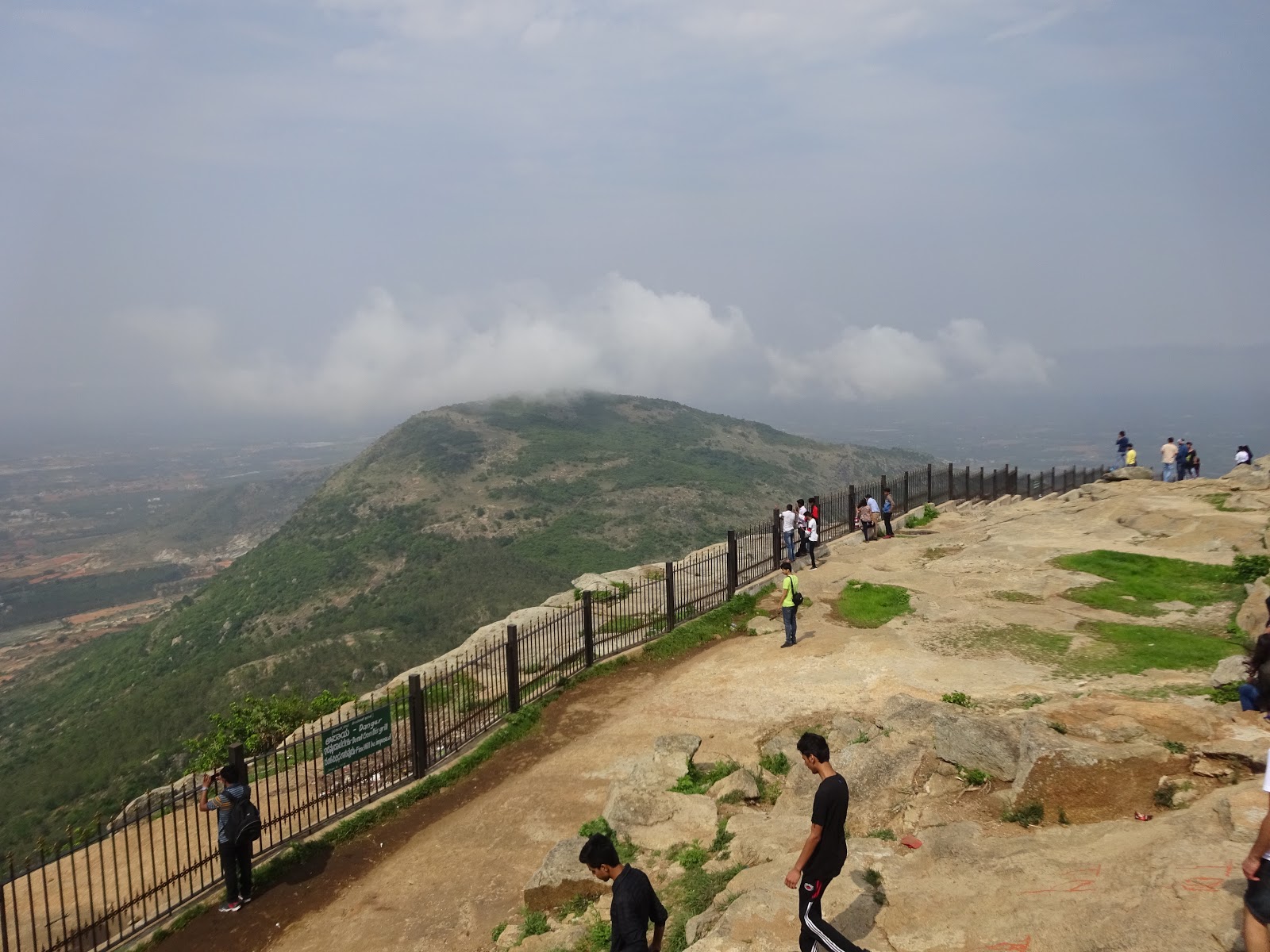
   Viewpoint                                                                                                                                                                                                  Hills nearby


 Remnants of the Fort

The place was already crowded and everyone was lapping up soft idlies by the dozens and crisp vadas. There were special counters for masala dosas. We too bought the coupons and had our fill. Hot coffee was available. Imagine getting all this homely stuff on the very top of a mountain!

Then we strolled leisurely across the length and breadth of Nandi hills, passing the viewpoint, the broad premises of the temple, beyond it to the canopy with a raised platform. The wind was so strong it would have blown any person who was thin and not strong! From the viewpoint, one can see the rolling fields, villages, houses and roads crisscrossing the valley below.

We climbed down the vast rock formation which slopes down the hill and reached the spot where Tipu’s Drop is situated. Imagine the poor, unwanted prisoners being hurled along this bump and the precipice to their certain death!

There are also Tipu’s Summer palace and secret way out of the Hills, but were in dilapidated condition. Gandhi House is there too where he is supposed to have stayed. Rivers Pennar, Palar and Arkavati are said to have their origin in this mountain, but all we can see today are the dry sources. Amrit Sarovar Tank is there still with lot of water. 
                                    
                                                                    Natural entrance to the KSTDC Restaurant

Having worked up an appetite, we trouped up to the Hotel Mayura Pine Top, run by Karnataka State Tourism department. After having a nice meal, we roamed around a little more and left the place reluctantly by four pm.


Garden below the Pine Top Restaurant

For youngsters, there is paragliding and cycling. A flight of 1175 steps lead to the top from the very base of the mountain; if you are a trekker, you would enjoy the climb. Motor cycling is the most loved of venture for the youngsters.

Nearby are Skandagiri hills of 1340 m high with a fortress as well. Sir M. Visveswariah, the renowned Engineer and Deewan of Mysore, who build the KR Sagar dam and Brindhavan Gardens, was born in a village nearby, called Muddenahalli, which has a museum.


But simply to be on the top of Nandi Hills and savour the beauty of the place is in itself is the main charm of the place. No wonder people are attracted to visit the place again and again. And it is simply worth it, believe me.